Destinations for the day
From Moulay Idriss du Zerhoun we drove south to Meknes where we visited several famous and interesting sights and then we were off to Fes in the later afternoon where we stayed for two nights.

Meknes
Historically Meknes was one of the four Imperial cities of Morocco. The city was founded in the 11th century as a military settlement and later became the capital of the kingdom under the reign of Sultan Ismail Ib Sharif in the the 16th century.
Driving into Meknes was like driving into a huge traffic congestion. The roads were jam packed with cars, buses, vans and trucks. Honking and dust filled the atmosphere. Wow this was certain a busy and densely populated city!

We were in Meknes to visit several attractions, the main ones were Bab El Mansour Laalej and Mausoleum of Moulay Ismail and the others were Al-Hadeem Square, Dar Jamai Museum, Meknes Medina and Le Portail de Moulay Ismail. These attractions were all in close proximity of each other which meant we could park our car at one location and walk to visit all the attractions.

Bab El Mansour Laalej
We found a “parking space” and paid 20Mad. It was very near our first visit of the day, Bab El Mansour. Bab El Mansour was a monumental gate built in the late 17th and early 18th centuries. It was the main ceremonial entrance to the royal citadel of Sultan Moulay Ismail. Today it was one of the most famous admired landmarks of the city of Meknes.
The gate’s purpose was more ceremonial than defensive, aiming to impress visitors. It was named after the architect and designer of the gate, Mansour al-‘Alj. Another ornate gate, Bab Jama’ en-Nouar, also stands a short distance along the same wall. It had similar decoration to the larger Bab Mansour and was believed to also dated from the time of Moulay Isma’il.
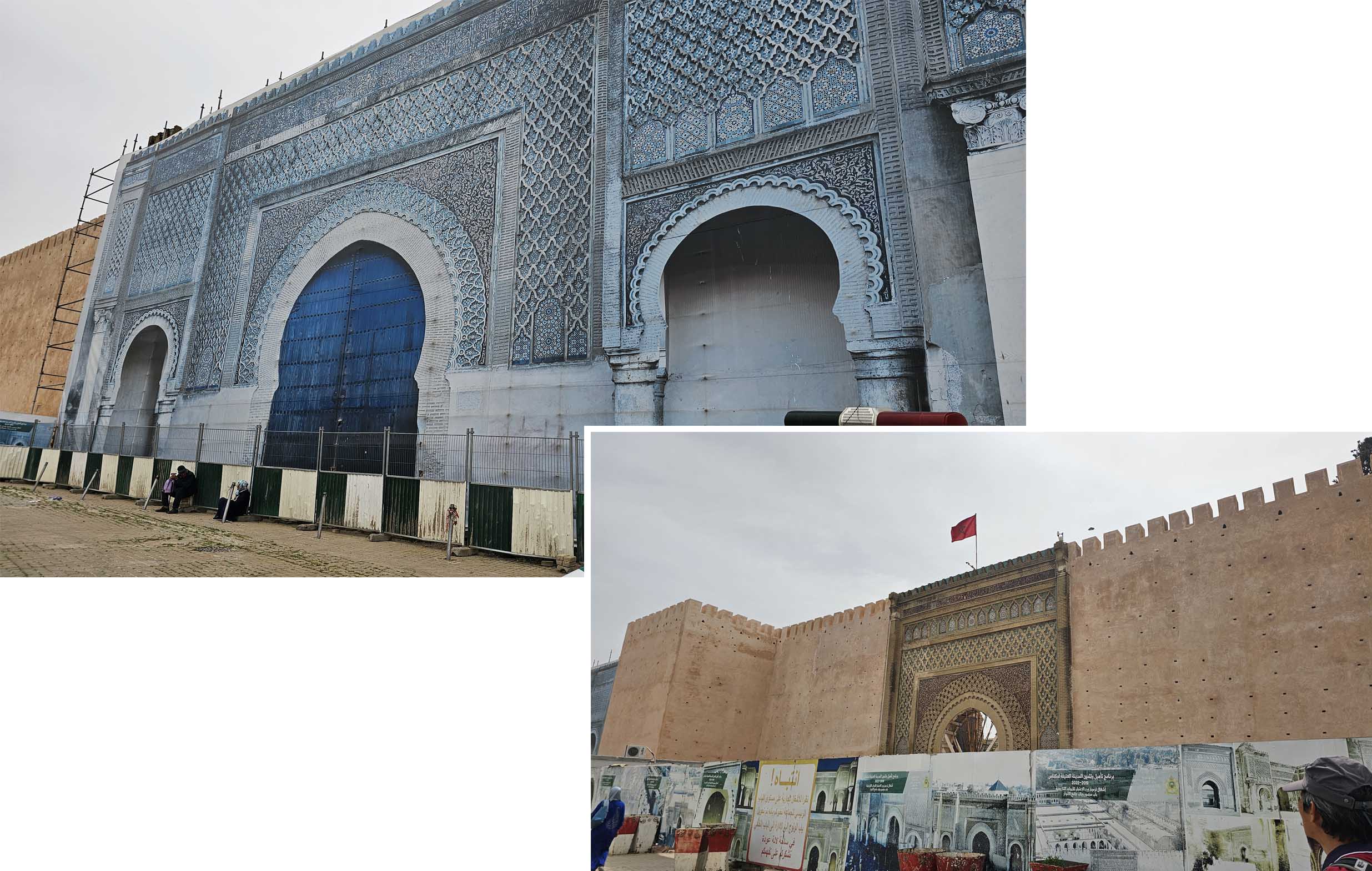
It was a short 300m walked to Bab El Mansour. On reaching the gate we were sadden to see it boarded up for renovation. The main gate was covered by a fabric with a printed picture of the gate.
This gate was not a “one dimensional gate” it was a complex with square bastions, archways and columns decorated with repeating motif, mosaic tilework, elaborate Arabic inscripiton topped with small “saw-tooth” merlons. All these beautiful descriptions that we had read about this gate was not for us to view. So sad that the first of our two main attractions in Meknes was not “viewable”!
El Hedim Square & Meknes Medina
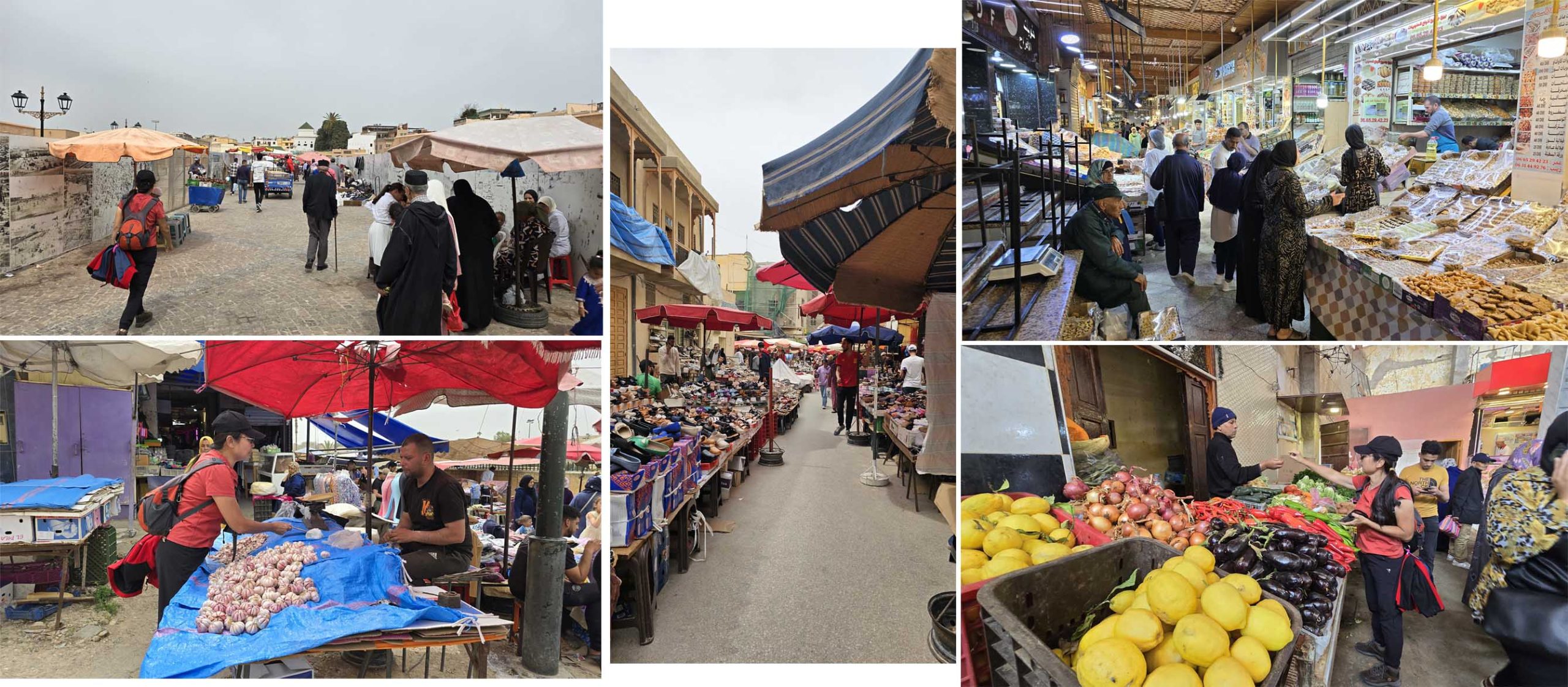
Walking across the road from Bab El Mansour was El Hedim Square. This square was built in 1672-1674 by Sultan Moulay Ismail as a public space for royal annoucement, market and militiary parades. Walking into the square we saw several food vendors, After crossing the square we reached Meknes Medina and there we saw many market stalls selling daily foods and wares.
Dar Jamai Museum
Just on the northern edge of the square was Dar Jamai Museum. It was constructed in 1882 as home of Meknes’s Jamai family. This museum reflected the opulent lifestyle of Morocco’s elite with its grand halls, ornate ceilings and beautiful landscape gardens.
In 1912 during the French occupation, it was used as a military hospital and then a military court. In 1920 it was turned into “Museum of Indigenous Arts” that delved deep into Moroccan rich heritage and displaying exhibits showcasing the skills of Morocco
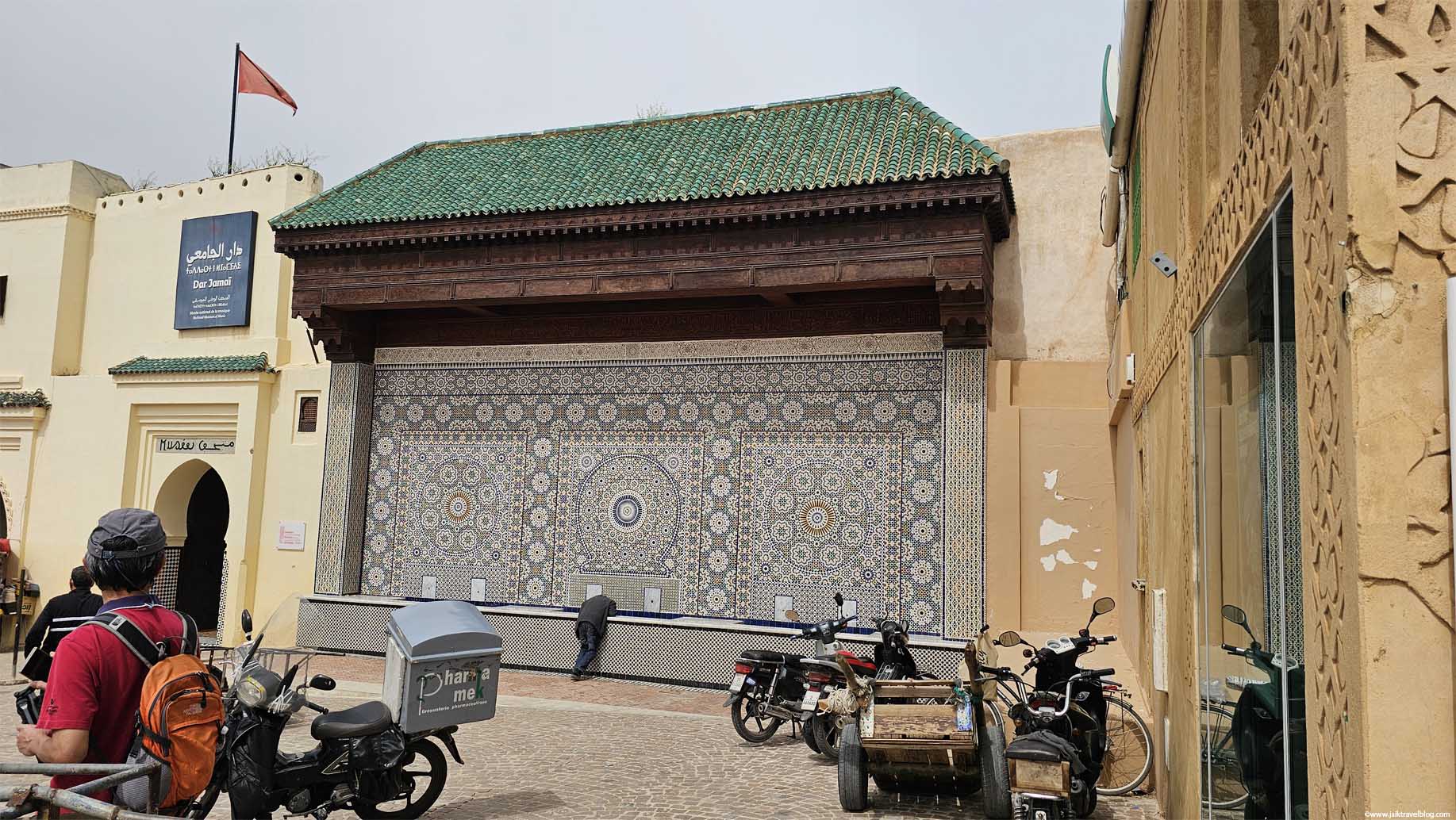
Outside the Museum was a large street fountain with a huge impressive tiled (elaborate zellij) wall as its backdrop. This backdrop adjoined to the exterior wall of the museum and faced the El Hedim Square.
The entrance into the museum was a small and insignificant doorway standing just beside the impressive street fountain. We did not go into the Museum as we were saving the time for visit to other places where we would also see the impressive skills of Moroccan artisans.
Le portail de Moulay Ismaïl
We left El Hedim Square, crossed the road back to the “boarded up” Bab El Mansour, turned a corner to our carpark then walked toward Mausoleum of Moulay Isma’il. On the route we passed Le Portail de Moulay Ismail.
Le portail de Moulay Ismaïl was part of the historic city wall and was another smaller scale monumental entrance to the historic city.
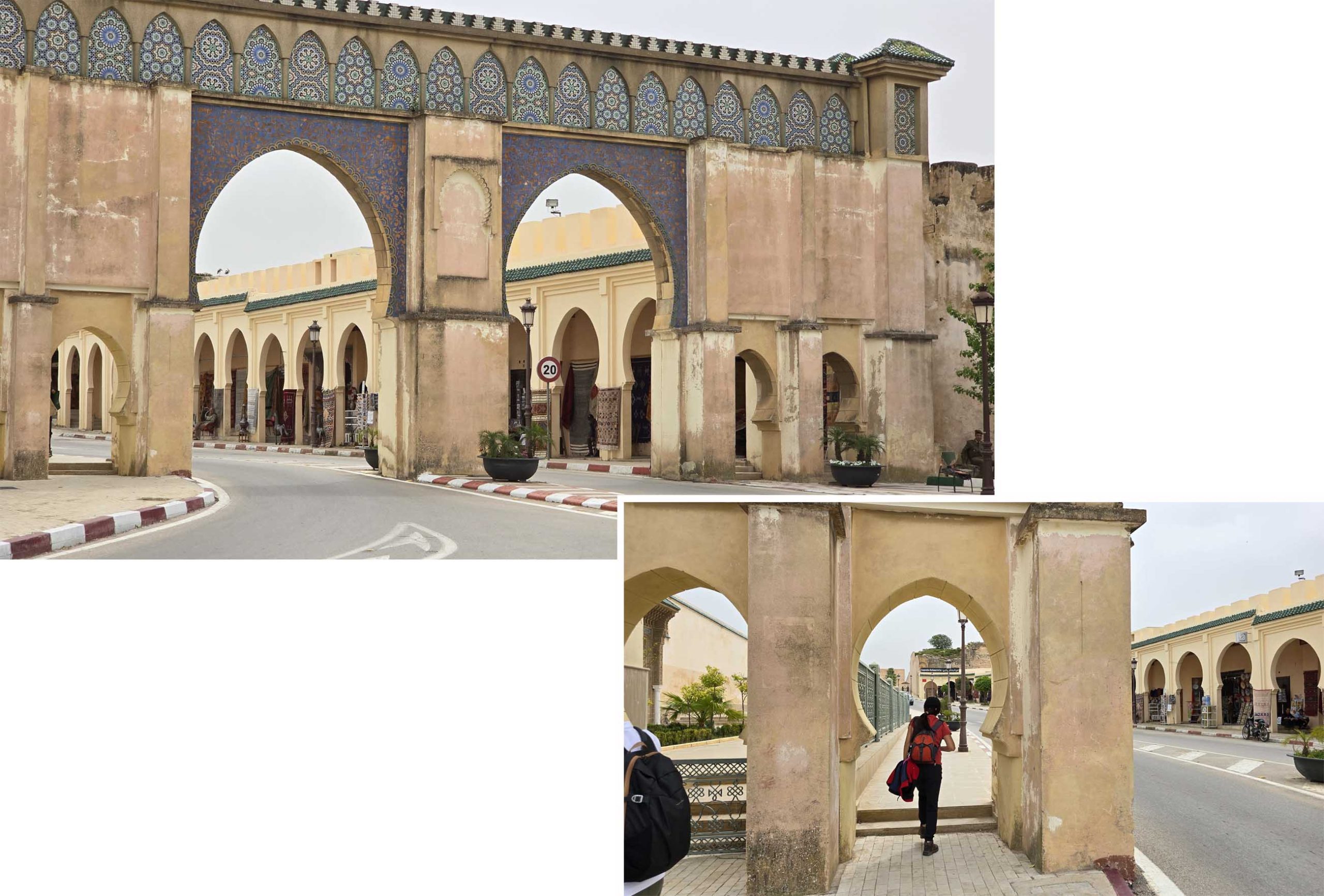
The gate consisted of two big arches than spanned acrossed the road and four small arches (two on each side of the big arches) for pedestrians. Near the top of the big arches were intricate tiled works which were too far “for the eyes to appreciate”. Walking right through the smaller arches and down the pedestrians walkway we would reach the Mausoleum of Moulay Ismail.
Mausoleum of Moulay Isma’il
Sultan Moulay Ismail ruled Morocco from 1672 till his death in 1727. As sultan, Isma’il’s 55-year reign was one of longest in Moroccan history. His mausoleum was located on the southwest side of the former Dar al-Kebira Palace, in a space that was formerly between the inner and outer perimeter walls of the palace. Though the palace itself was not able to withstand the centuries since its construction, the Mausoleum has been maintained to this day.
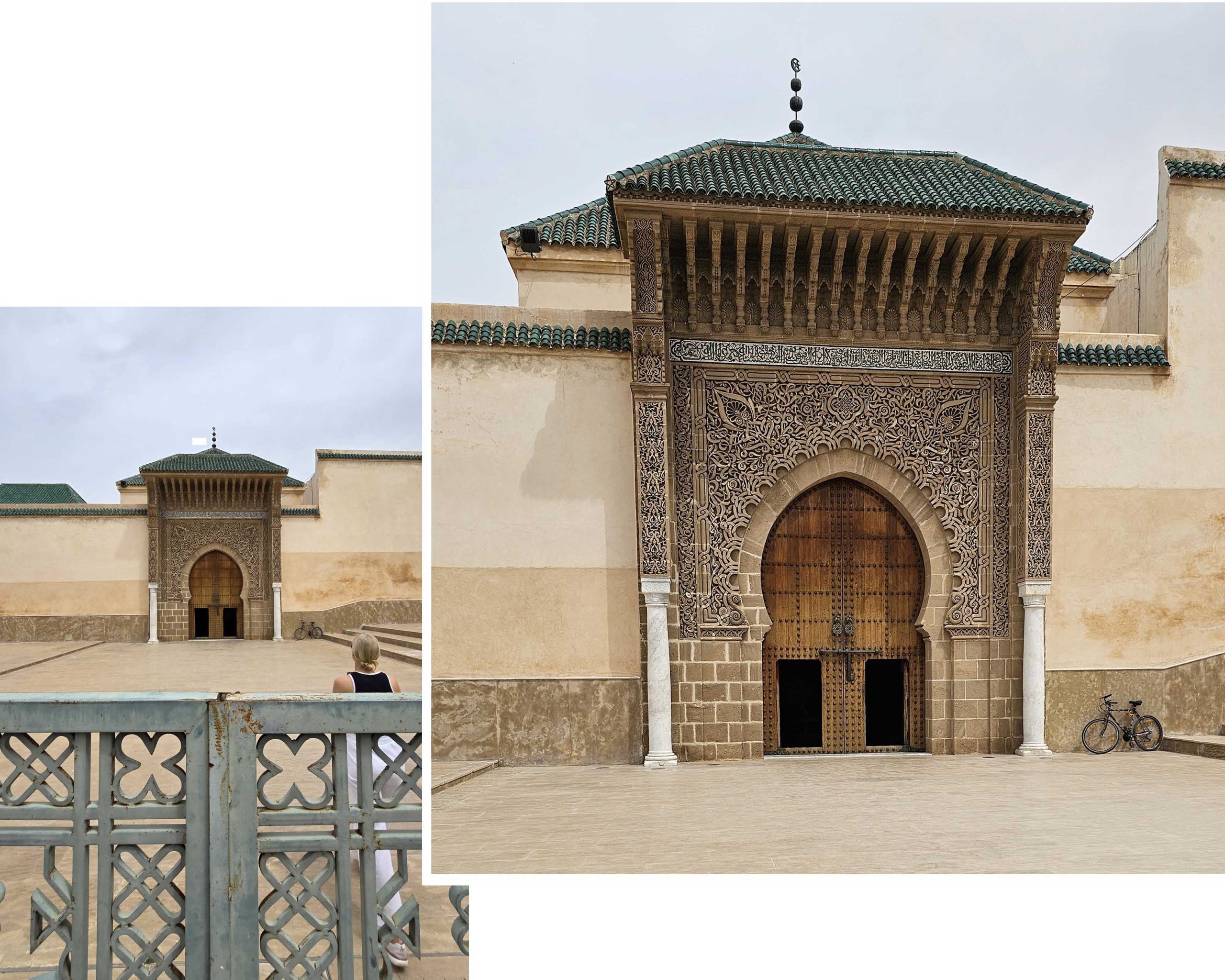
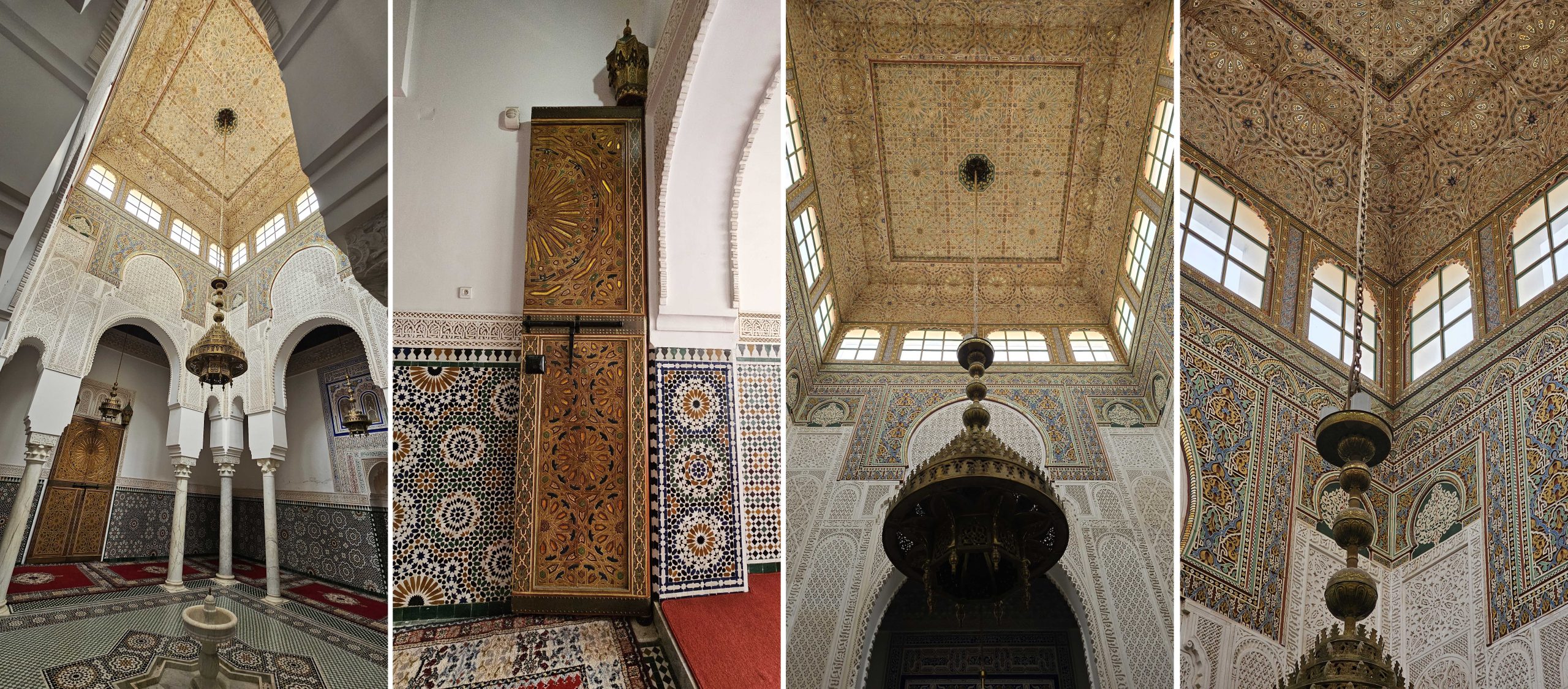
The funerary complex consists of various courtyards and chambers. The main central courtyard, located on the west side of the tomb chamber, is sparsely decorated except for a central fountain and zellij pavement.

The western and eastern sides of the main courtyard are occupied by porticoes of three horseshoe arches. On the eastern front of the main courtyard was the mausoleum chamber and adjoining rooms with indoor patio/courtyard covered by a high cupola ceiling
We did not get to entered into the tomb chamber of Moulay Ismail as non-muslim are restricted from entering the room. The cetnral chamber housed the tombs of Moulay Ismail, one of his wives and two of his children. Though we not permitted to enter the -chamber we could still see the beauty of the chamber from the outside.

The mausoleum of Moulay Ismail was a great “show place” of the skill and creativity of Moroccan craftmen. The intricate tirework was awesome you see it everywhere, on the floor, on the fountains, on the walls on the archways. The details were remarkable, the small geometric patterns coming together to form a bigger patterns were fascinating. There were calligraphic inscriptions, floral motifs and vibrant colors of blue, green and gold. This grand complex clearly demonstrated the vast richness of the dynasty.
Unlike the Bab El Mansour Muesum, there was no entrance fee to the Mausoleum of Moulay Ismail.
Coffee Break with a view
My the early afternoon we were done with all the important attractions of Meknes and it was time to stop for coffee break. We went into Palais Salma Restaurant and went up to its highest level for a cool drink. Our table overlooked a garden/fountain to an arch gate.
