Meknes to Fez
From Meknes to Fes/Fez was about an hour drive. We drove all the way to our stay at Fes. Our stay was near Bab Ziat, one of the many gates of the old medina of Fes. We were not too sure where we should park our car but once we drove through the gate, there was already parking on the sides of the road. It was paid parking and we paid 55dh for two days of parking.

The host of our stay was quick to recommend that we engaged a guide to bring us to all the prominent places in Fez. The guide fee was 450dh for about 6-7 hours just to bring two of us around.
Though we had two days/nights in Fez we were already tired out from our morning exploration in Meknes and on reaching Fez we just wanted to rest and relax at our stay for the rest of the day. Engaging a guide to bring us around on the 2nd day would cut out unessential wasted time wandering about.
FEz
Fez was a city in northern inland Morocco with a population of 1.3 million. It was founded in the 8th century under the Idrisid rule. After the fall of Idrisid dynasty other empires came and went until the 11th century when Almoravid Sultan Yursuf ibn Tashfin ruled Fez and gained a reputation for religious scholarship and mercantile activity.
Fes el Bali was the older part of Fez medina, this medina was founded as the capital of the Idrisid dynasty between 789 and 808AD. Fez el Jdid was built in the 13th century by the Merinid dynasty as an extension of Fes el Bali to give the city a new dimension. The objective of the Merinids was to build a fortified administrative city containing mosques, barracks, markets, dwellings and a royal palace to house the princes of the new dynasty.
The medina of Fez consisting of both Fes el Bali (old medina) and Fes el Jdid (new old medina) is listed as a World Heritage Site.

South of the medina of Fez was Ville Nouvelle (New Town) which was a relatively modern central district of Fez bullt by the French in the early 20th century. This neighbourhood was originally designed to accommodate foreigners and affluent Moroccans only.
Jnan Sbil Garden
We met our guide at about 9am in the morning and the first place he brought us to visit was Jnan Sbil Garden. We were not fans for curated garden, but went along.
This garden was also known as the Bou Jelou Garden, it was a public garden located between the old and new medinas, Fes-el-did and Fes el-Bali, on the northern side. The gardens were opened to public in in 1917. Previously it was exclusively for royal elites and were connected by underground passage from the RoyalPalace.
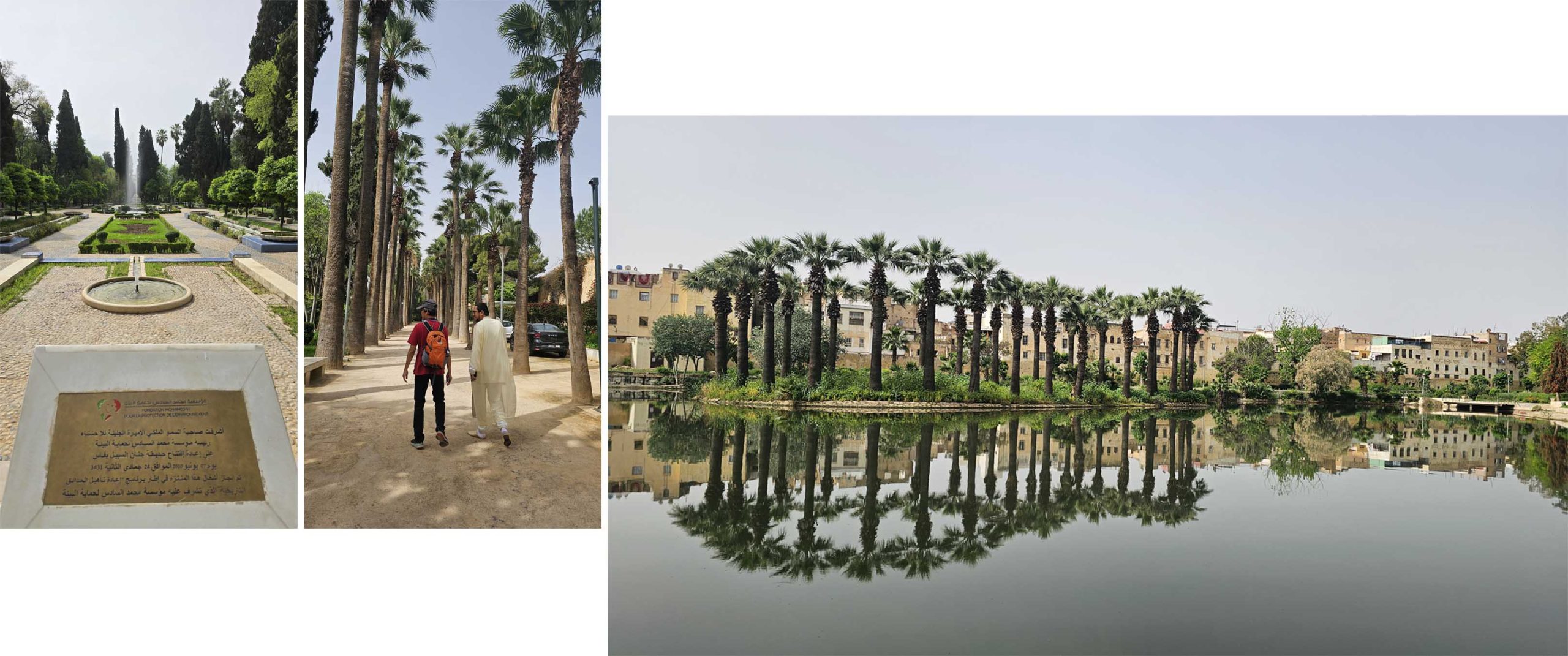
This garden went though a period of neglect and was renovated between 2006 to 2010 before reopened to the public in 2011. To us who lived in a tropical garden country, Singapore, extensively covered with greenery this garden was not “our cup of tea” but in a “desert like” city like Fez, this garden certainly was of “exceptional beauty” to the locals.
Mellah and FAben Danan Synagogue
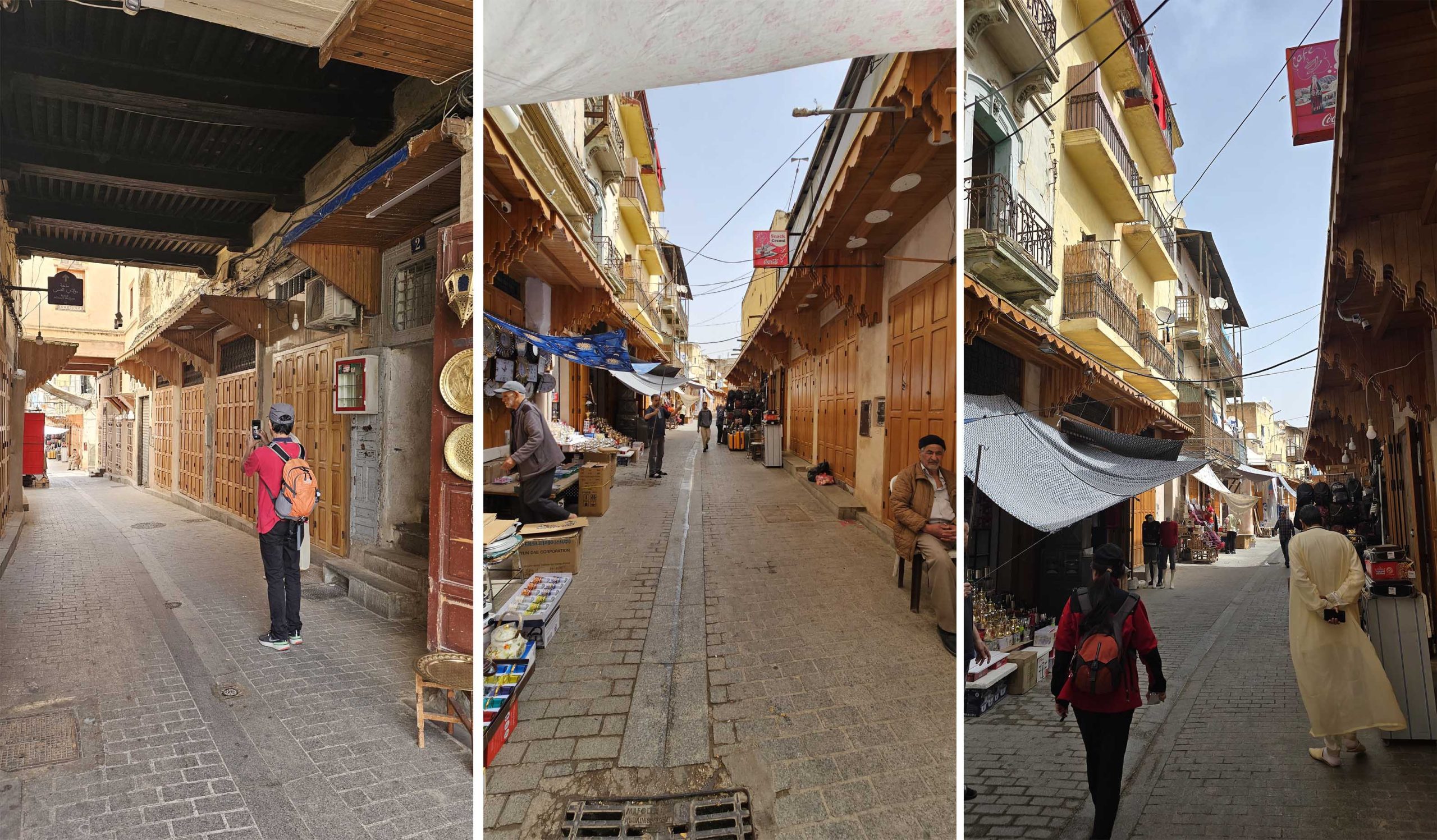
We drove to the south side of Fez el Jdid and walked into the Mellah of Fez. This was A historic Jewish Quarters built in the mid 15 century on the southern part of Fez el Jdid. This mellah was no longer the home of any significant Jewish population, it still contained a a number of monuments and landmarks from the Jewish community’s historical heritage in the city.

It was about 10am in the morning, still early, so the street shops were closed. The streets are cobbled, clean and tidy. The doors to the shops by the sides of the streets looked new. A couple of shops were opened and there were not many shoppers on the streets.
We were in the Old Jewish Quarter to visit a prominent place of worship, Aben Danan Synagogue. The doorway to the synagogue was rather modest and one would not have known that it led into a very special place.
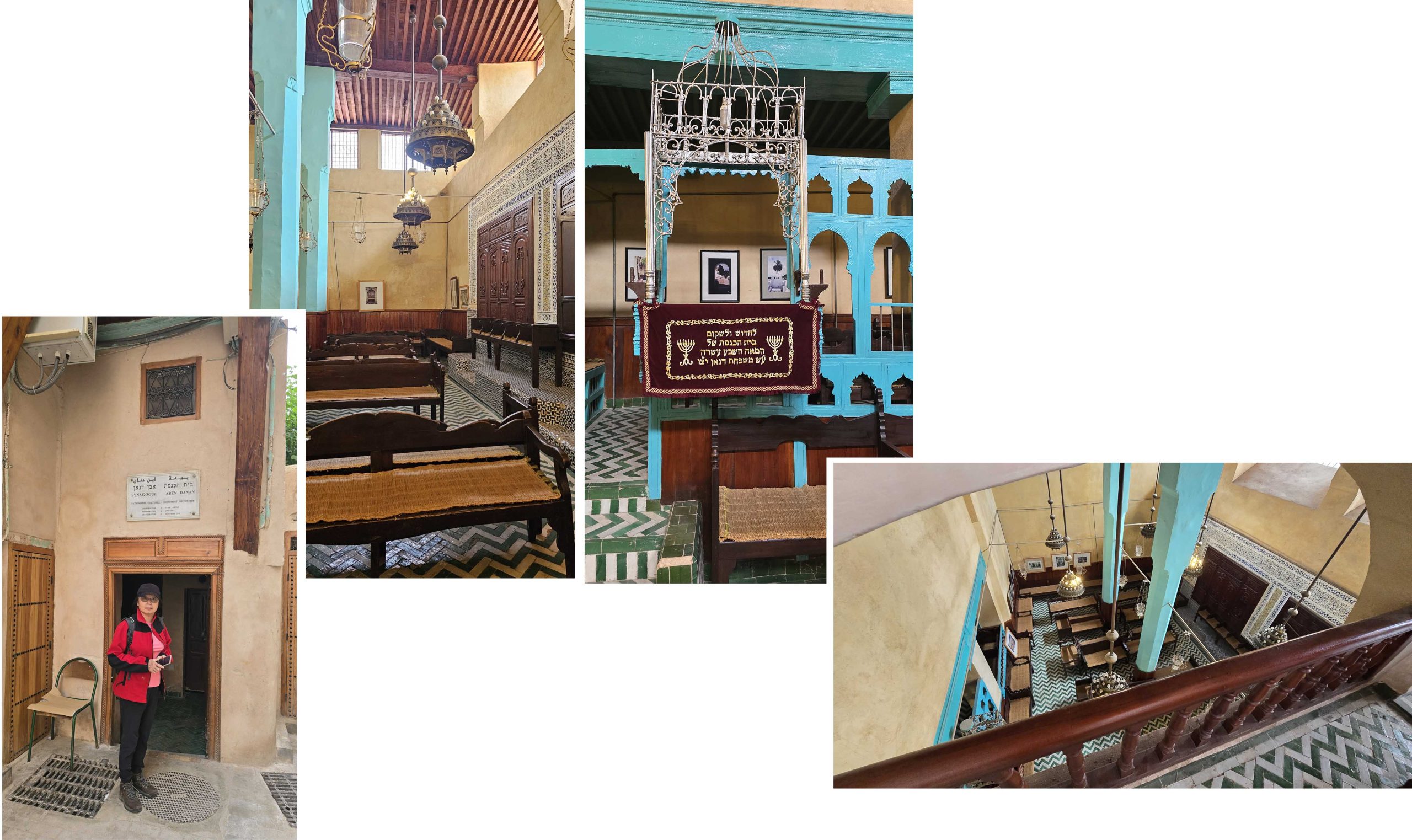
Aben Danan Synagogue also known as Ibn Danan Synagogue was built in the 17th century by a rich merchant (Mimoun Ben Sidan) during one of the most turbulent periods in Sephardic Jewish History. It was built to accommodate the massive flux of Jewish refugees (1500 families) into Fez following the Spanish Inquisition and subsequent expulsion from the Iberian Peninsula.

There was a narrow staircase that led to the upper floor of the synagogue. There was a big hall with similar “zigzag” tile floor as that of the lower level. On this higher level was also a couple of bare rooms which we had no idea of their purposes (our guide did not came along with us to the upper floor so we were not “enlightened”).
Compared to many “grandious” buildings we had visited in Morroco this far, we would say Aben Danan Synagogue was rather plain looking, both interior and exterior. It was special in due to its historical and cultural representations.
Palace of Fez
From Aben Danan Synagogue, our guide took us through the streets of the Mellah to the Royal Palace of Fez. This was where the King of Morocco and the royal family would stay whenever they were in Fez. The vast grounds were home to multiple private structures, patios and garden which were not open to the public. The public could only seen the main entrances of the palace which were located at he Old Mechouar (to the northeast) and Place des Alaouites near Mellah (to the southwest) where a highly ornated 20th century gate stood .
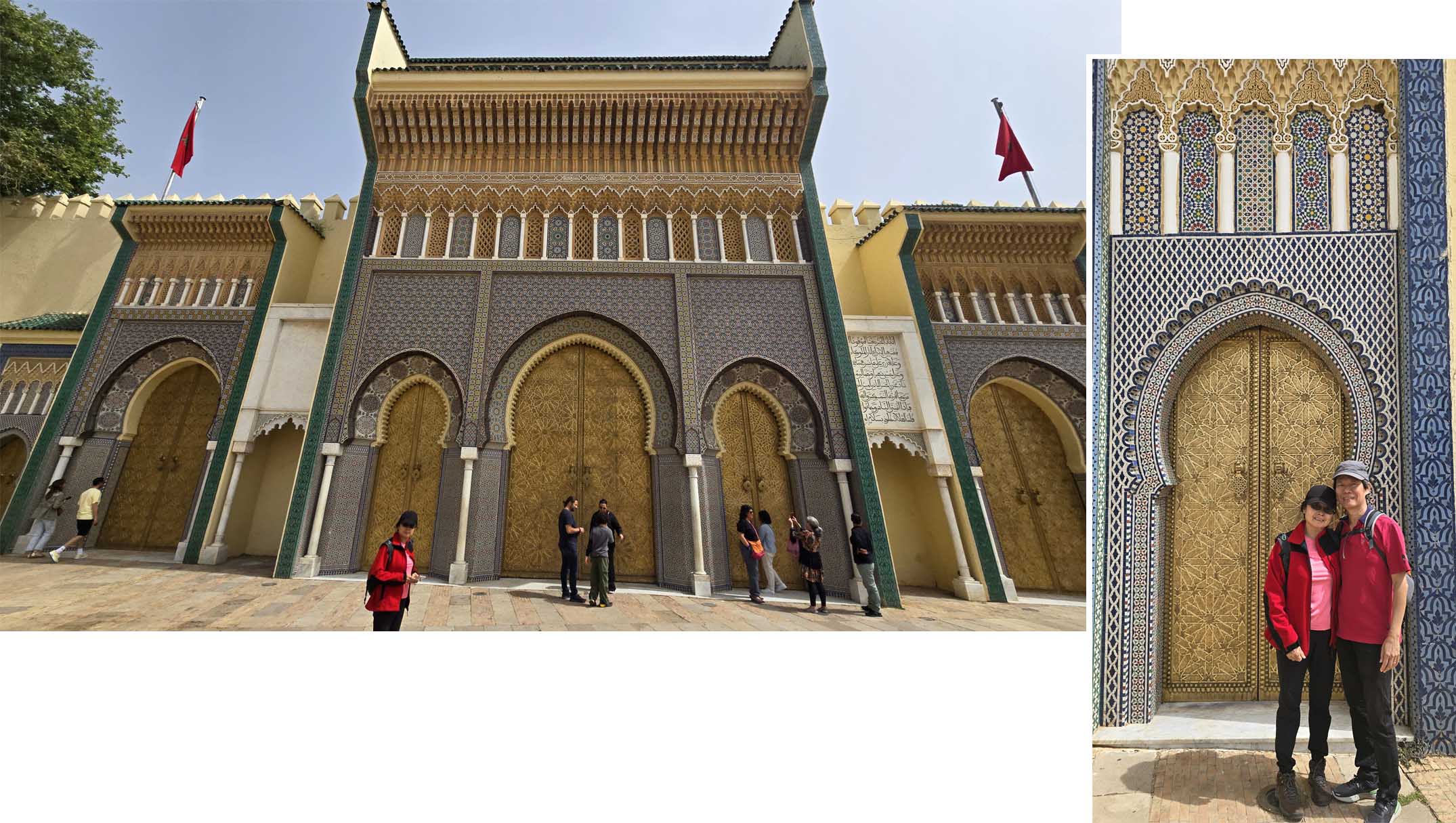
The ornated gates were beautiful with golden huge doors. These gates “oozed oppulence”!. The more we saw of mosques, palaces and mausoluems the more we realised that Morocco was a extremely rich country.
Borj Sud
Borj Sud also known as the South Tower/Fort was first established around 1582 by Saadian dynasty. It was sited on the southern side of Fes el Bali overlooking the old city. This fort was one of the several Forts that were built around the city. The Saadians whose capital was Marrakesh faced notable resistance to their rule in Fez and these forts were intended to keep the restless population of the old city under control and at the same time defend the city from external attacks.

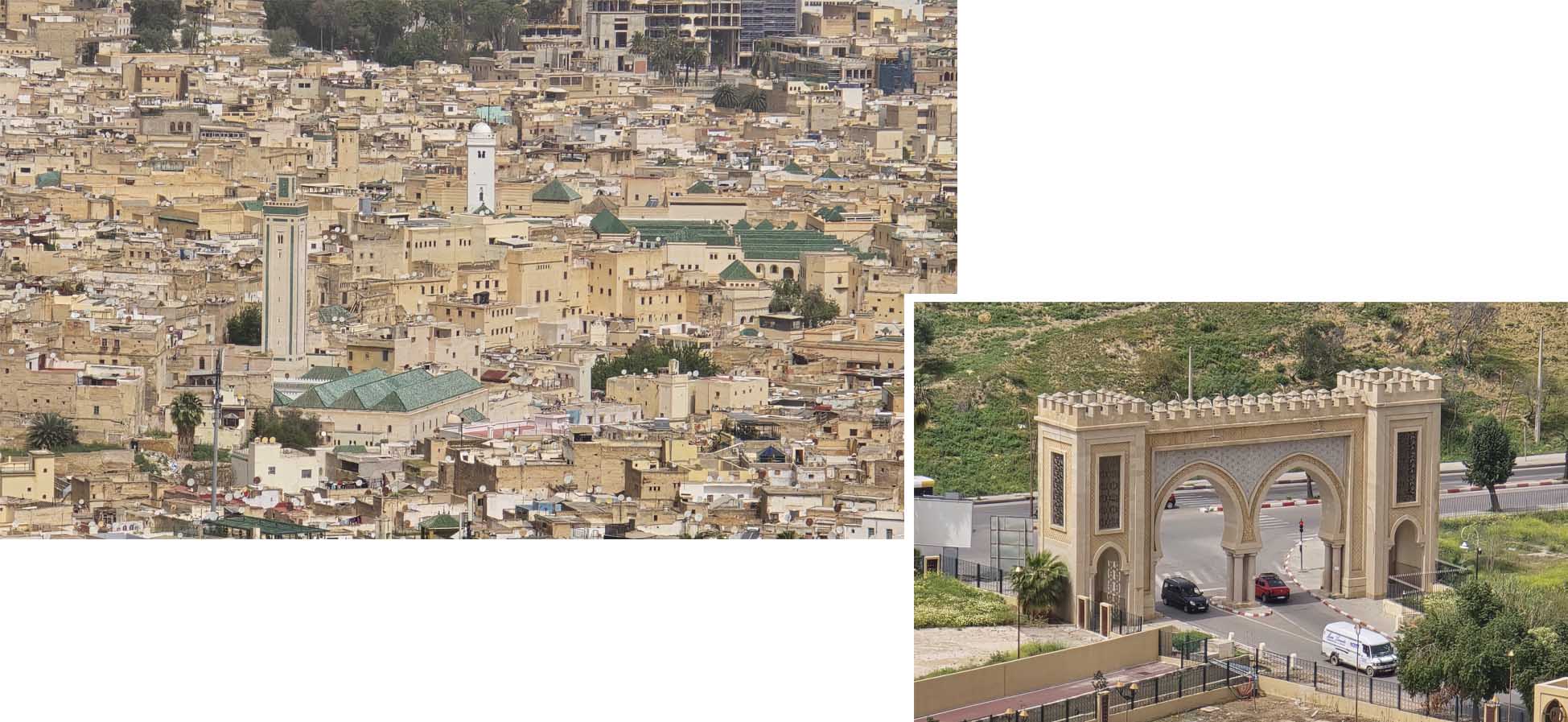
Walking on the ground of the fort we were able to view the old city/medina from afar. Wow the city was indeed very huge. According to our guide, there were about 9000 to 10000 streets in the medina. Streets, houses, palace, garden, university, souks, mosques, synagogues all packed into 2.4 square kilometers. A living museum.
Moroccan Craft
Art de Poterie Ach in Fès was an artisanal terracotta workshop a few km east of Fes el Bali. Our guide brought us there to see moroccan craftmen at work. The Art de Poterie Ach Company was owned and operated by Idriss Fenassi. This company produced Morroccan handmade pottery using a ancestral techniques.

At the entrance yard we saw neat rows of rectangular grey tiles sunning on the floor. Our guide mentioned something along the line of tile creation, coloring and then chipping down to small pieces. He brought us to a small enclosure where we saw craftmen at work. A craftman using a some sort of wooden hammer with a thick trapeziod wooden head with a flat on one side, he used it to hit on a piece of rough clay. After flattening the clay into a smoothen layer, he put a boxy template on top of the clay layer and sliced off the excess just outside the boundary of the template. These grey tiles would be later out to dry in the sun.

The dried tiles were then colored and glazed and carefully broken into pieces. We saw all that at another location where a craftman painstaking chipped/chiselled glazed tiles into pieces into many uniform mosaic pieces of different designs. Our guide told us that this “chipping to pattern/size” required more skills and the craftman would receive a higher pay than the earlier craftman making the tiles. They were paid by the number of pieces of mosaic made.
Chipping the “mosaic” one piece at a timeIn another location we saw craftman carefully assembling these pieces to form various beautiful patterns on the basis of tessellation. They would assembled the pattern based on the requested final product which could be a table top or a fountain or even walls. This visit gave us the step by step process of zillij or zellige tilework. It made us realised that all the beautiful zellige tilework in mosques , palaces and mausoleums were assembled from individually hand-made tiny pieces!

The next part of our visit brought us to the pottery section. There we saw another craftman spining the pottery wheel making various Moroccan potteries.

In another section we were able to see an artist creatively painting a typical Moroccan cookware, the tagine.


Our tour ended in the “sale” section where many Moroccan potteries, table tops, fountains, etc etc were displayed for sales. We did not bought any stuffs as the idea of carrying them home was too daunting. The owner told us that for the large pieces, he could arrange for delivery back to our home in Singapore. Unfortunately after some consideration we still did not bought any. They were beautiful but would not match our “style” at home.
Fes el bali
In the afternoon our guide was ready to bring us into Fes El Bali, the older medina in Fez. It was noon and the shops and stores were open. Walking through the streets were very delightful and colorful.
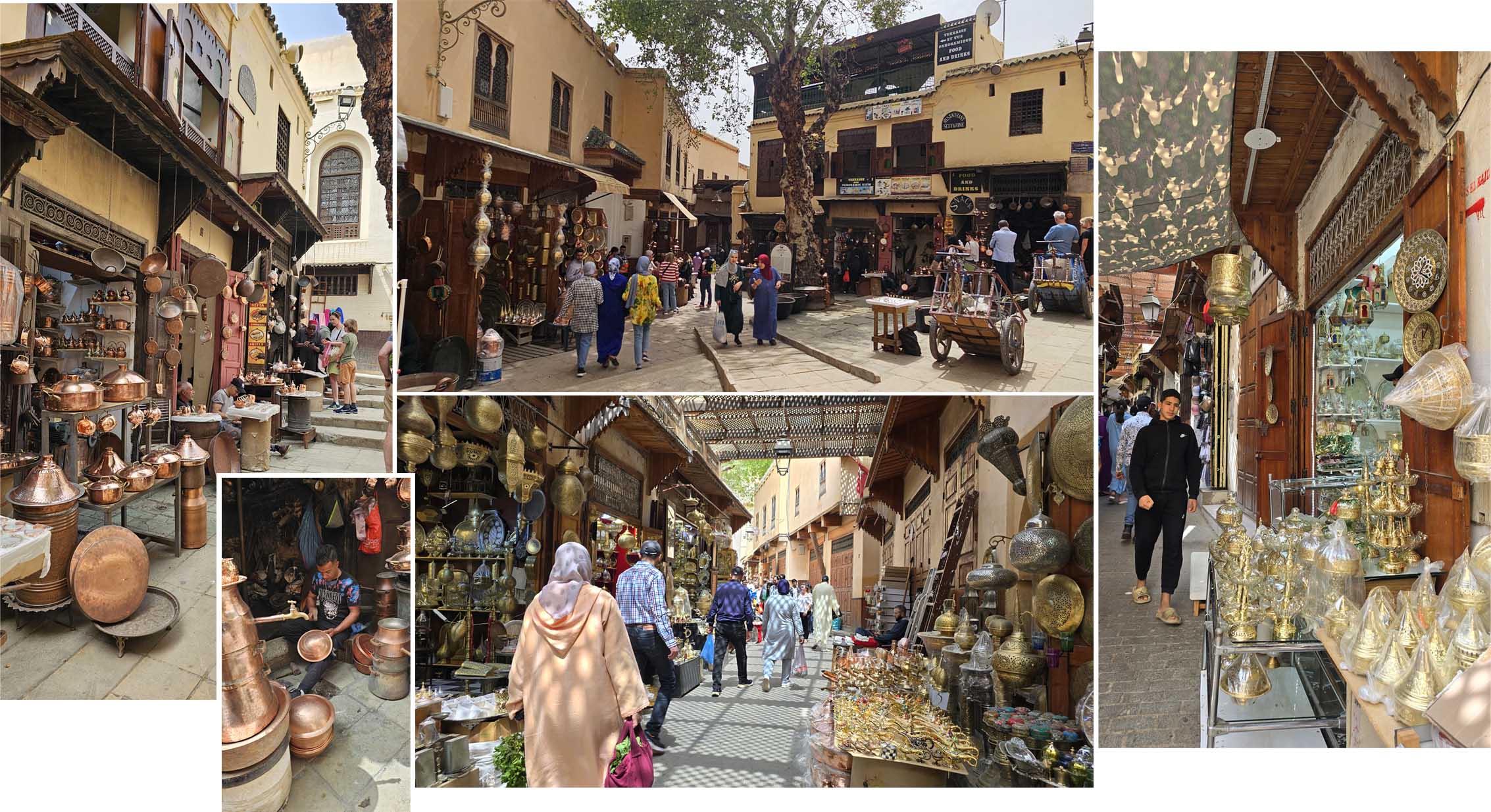
The products sold seemed to be segregated into different streets. Some streets specialised in food, some in cookwares, some in lights, some for clothes, spices and perfumes etc. In among these streets were various famous historical buildings which were also interesting to visit.

There was a “dyeing” street where a customer could bring their cloth or fabric and requested it to be dyed to a particular color. There we saw dyeing in process. Cool!

Walking through the streets that sold cooking utensils was so captivating. All sort of golden colored (bronze) big and small pots, of all kinds of shape and sizes, were displayed on the shelves of the shops, hung out at the shop front and decked out on tables along the walk way. These streets shimmered and shined under the sunlights.
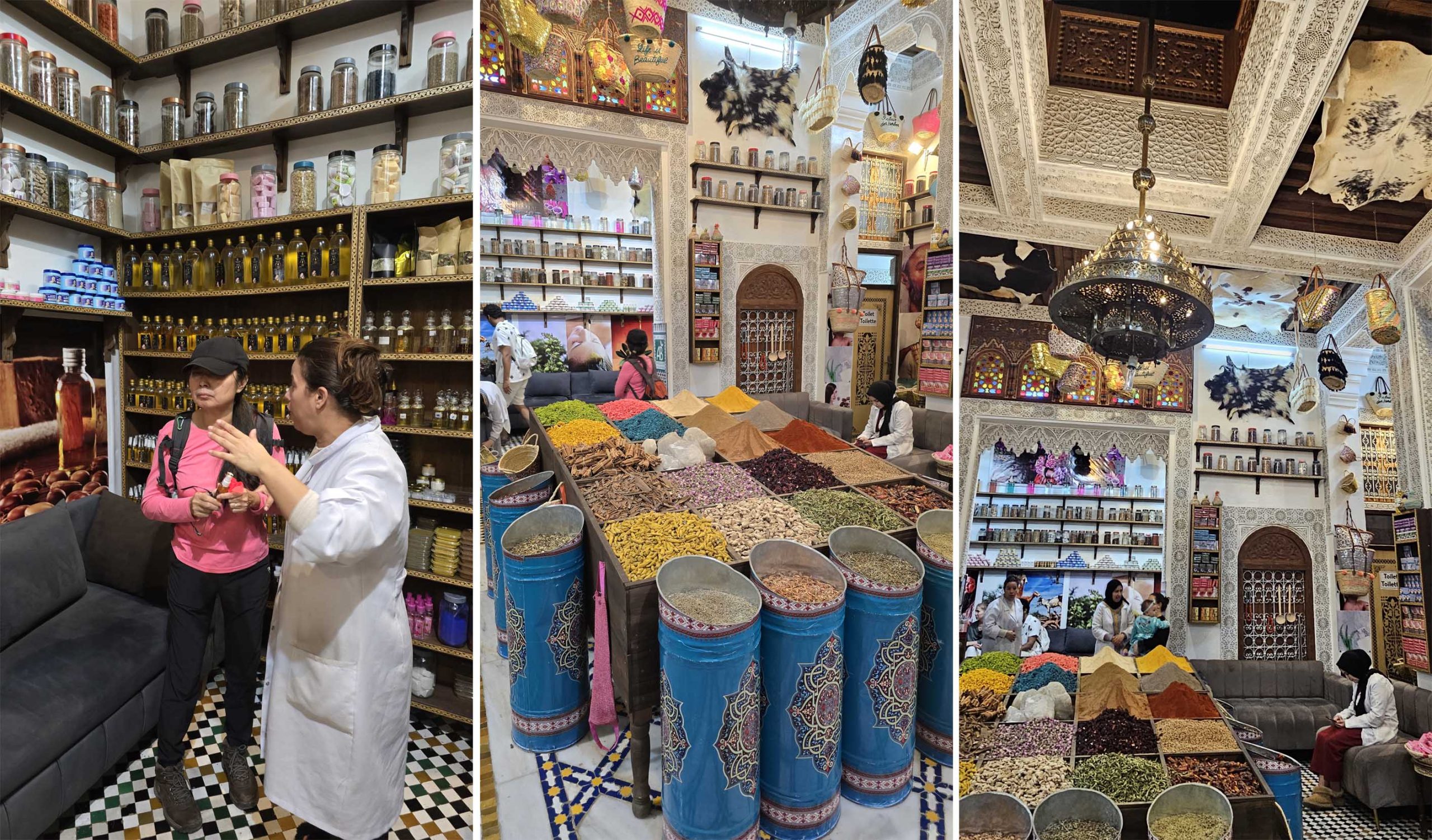
I was having a running/stuffy nose and upon knowing this, our guide brought us to a spice/perfume/cosmetic shop. There a lady (staff) in a white coat came by and “stuffed” some herb in my nose which improved my “stuffy” nose situation. At the store we bought some Argan Oil which was a famous product of Morocco.
Fondouq al-Staouniyine
Our first historical building in Fez el Bali was Fondouq al Staouniyine also called Funduq al-Tetwaniyyin. It was founded in the 14th century during the Marinid era. Funduqs were a type of urban caravanserai in Morocco. Funduqs served inn and commercial center for trade. They provided services and accommodations for merchants and travelers from outside the city.
The building consisted of a courtyard surrounded by a multi-storied gallery where rooms could be accessed. The galleries were supported by wooden lintels resting on square pillars and along the gallery were wooden railings/parapets. At the ground floor was large area used for storage of animals and merchandise and was the site for trading while the upper floors were for accommodations.
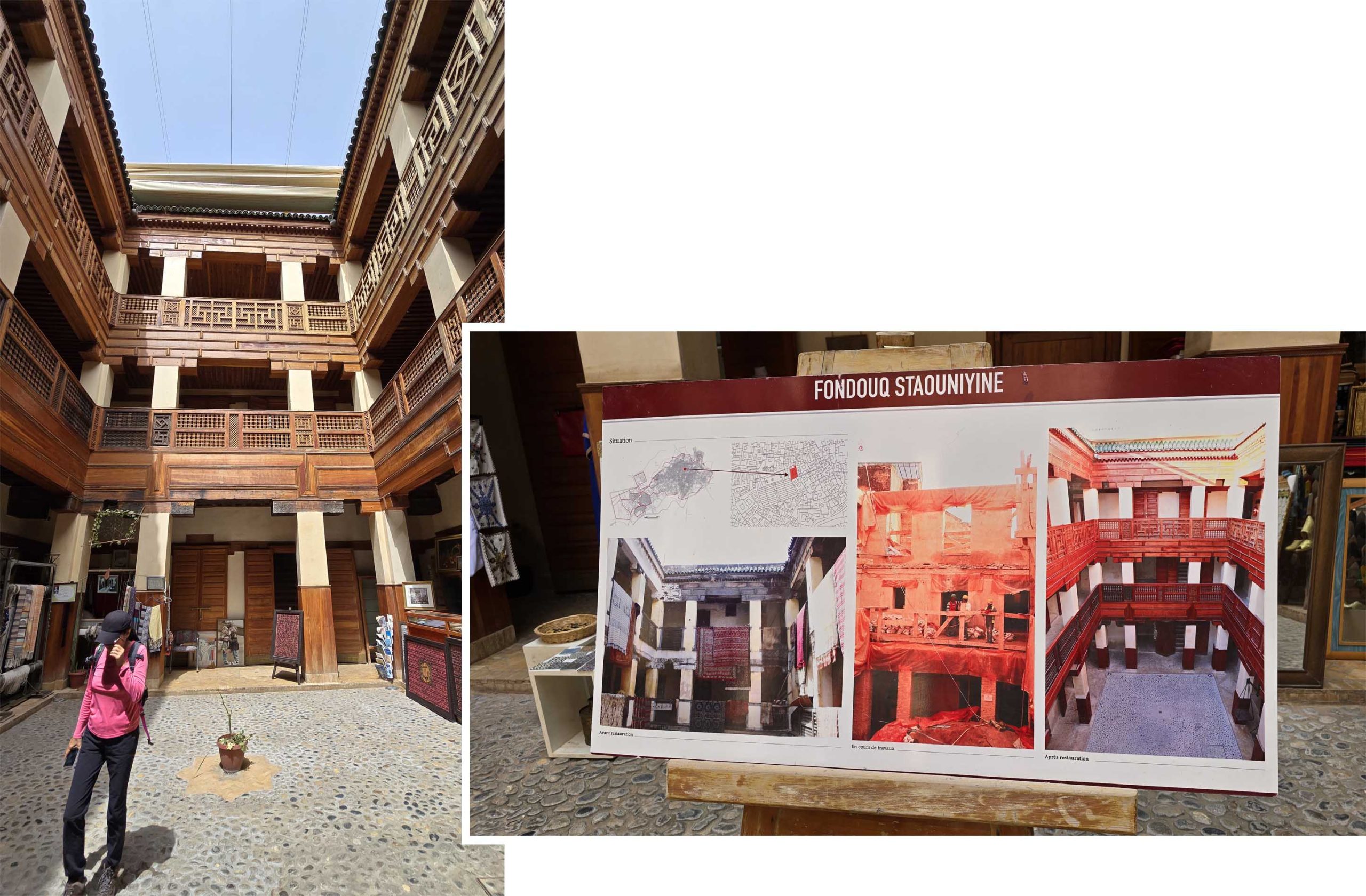
This building was classified as a national monument in 1925. It was more recently restored, along with a number of other funduqs, by the ADER-Fes heritage preservation agency, and reopened in March 2019 as a cultural and commercial center for artisans, with some modern amenities added.
University of Al Quaraouiyine
After Fondouq al-Staouniyine was a short walk to University of Al-Karaouine in Fez. This university was considered one of oldest university in the world. It was founded as a mosque in 857–859 and subsequently became one of the leading spiritual and educational centers of the Islamic Golden Age. It was incorporated into Morocco’s modern state university system in 1963 and was renamed “University of Al Quaraouiyine” two years later.
UNESCO and the Guinness World Records, had cited al-Qarawiyyin as the oldest university or oldest continually operating higher learning institution in the world. Education focused on Islamic religious and legal science, classical Arabic grammar/linguistic, muslim law etc. Students came from all over Morocco, West Africa and further aboard.
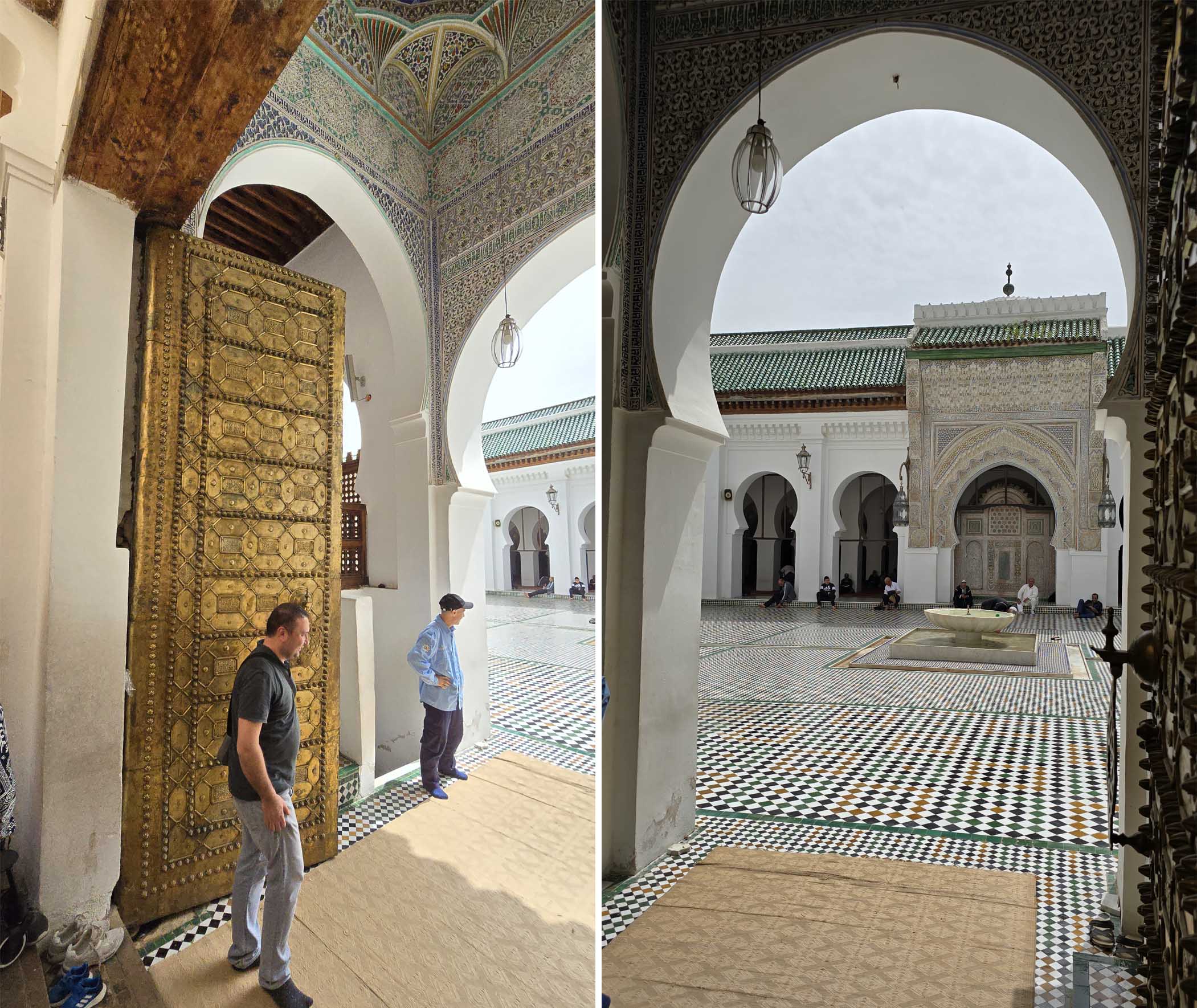
We never get to go into the university, as since the university doubled as a functionin mosque, non-Muslim visitors were not allowed inside the ground. We did get a glimpse of the tiled interior of the university ground throught its opened doorway.
Al Attarine Madrasa
Al Attarine Madrasa along with other nearby madrasas was built near to University-al-Qarawiyyin Mosque/University. Madrasas played a supporting role to the Qarawiyyin, they provided accommodations for students, particularly those coming from outside Fes. The madrasas were also teaching institutions in their own right and offered their own courses. It was built between 1323 and 1325 on the orders of the Marinid sultan Abu Sa’id Uthman II
The entrance fee was 20dh per person. Once we entered the courtyard we were amazed with the intricate Islamic architecture.
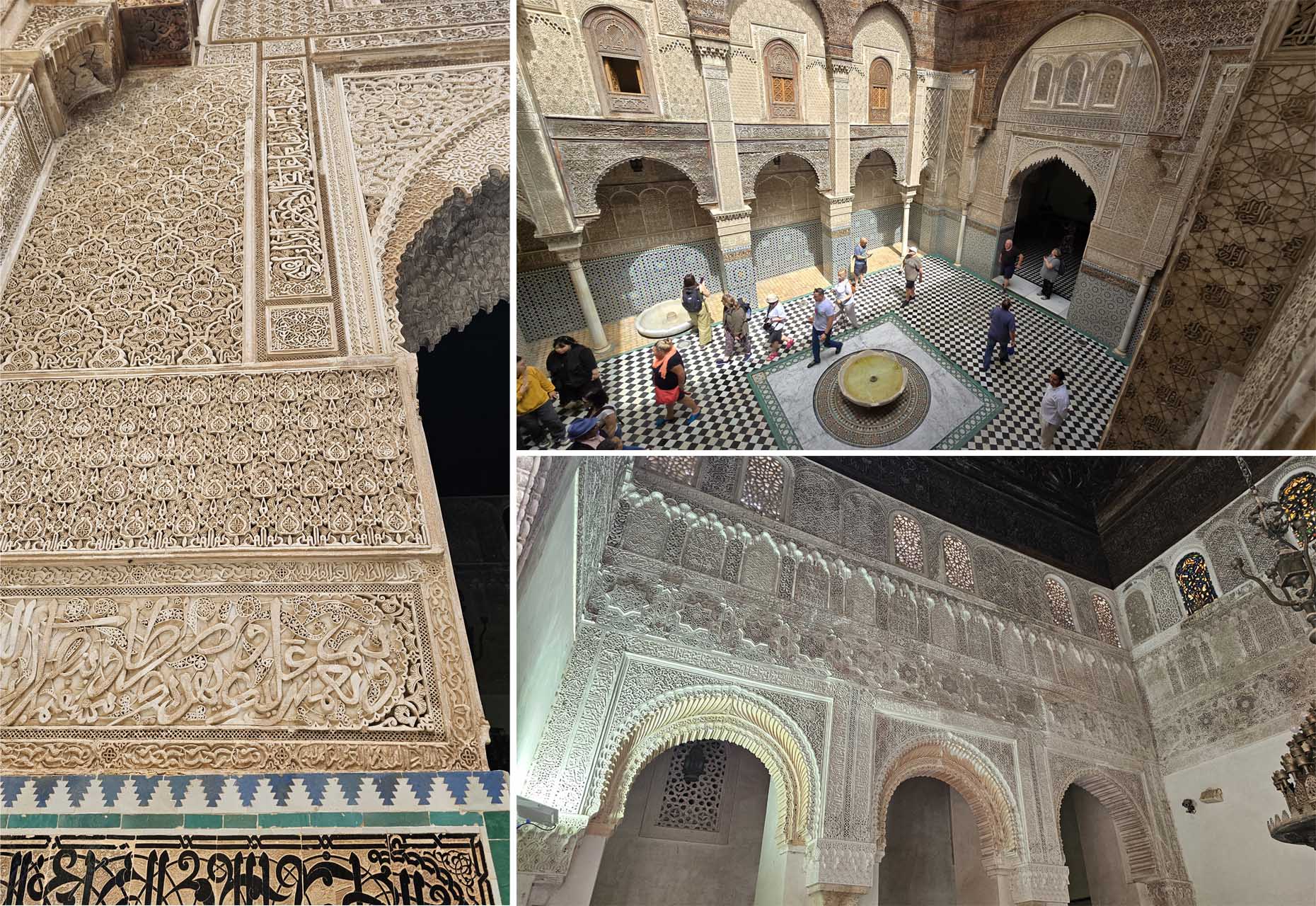
Looking at the wall, the plaster work or carving made it almost like “lace”. The madrasa took its name from the Souk al-Attarine, the spice and perfume market. It was considered one of the highest achievements of Marinid architecture due to its rich and harmonious decoration and its efficient use of limited space
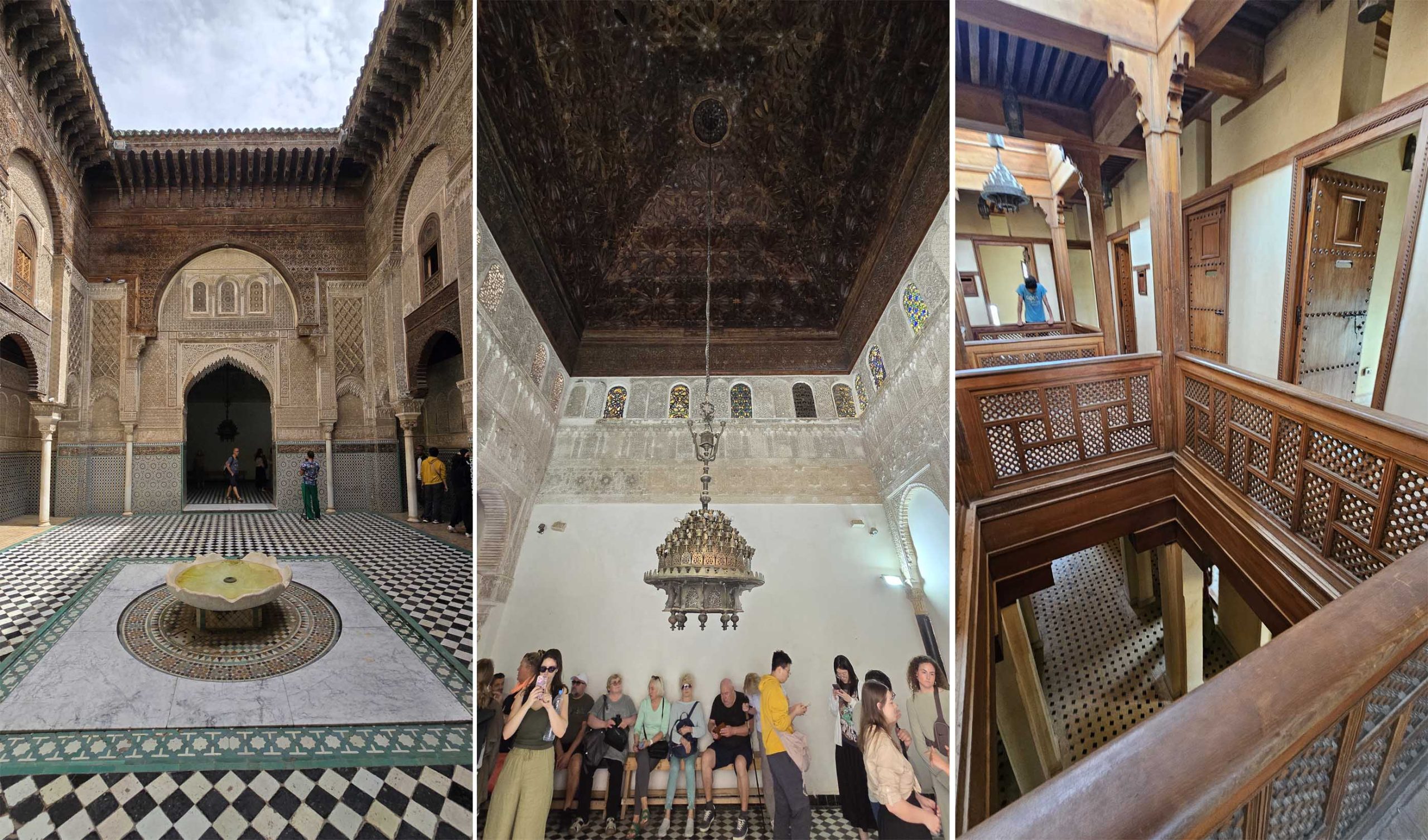
This madrasa was a two-story building and its upper floors were where the sleeping quarters of the students were located. We went up to the upper floors and explored the many rooms, the rooms were small but good enough for a person. Every room had a small window. Unlike University of Al-Karaouine, the madrasa was no longer used by students but was now a historic and cultural landmark.
Chouara Tannery
In Fez-el-Bali was a section that sold all sort of leather products, clothes, bags, etc. These products were not only design and created here it was also dye here. Chouara Tannery sometimes also called Chouwara Tannery was one the three tanneries in the city of Fez. Its was the largest and the oldest.
To see the tannery from a good top down angle, our guide brought us to a leather product shop, we had to go up to the third floors and from there was a huge window that looked down to the entire tannery.
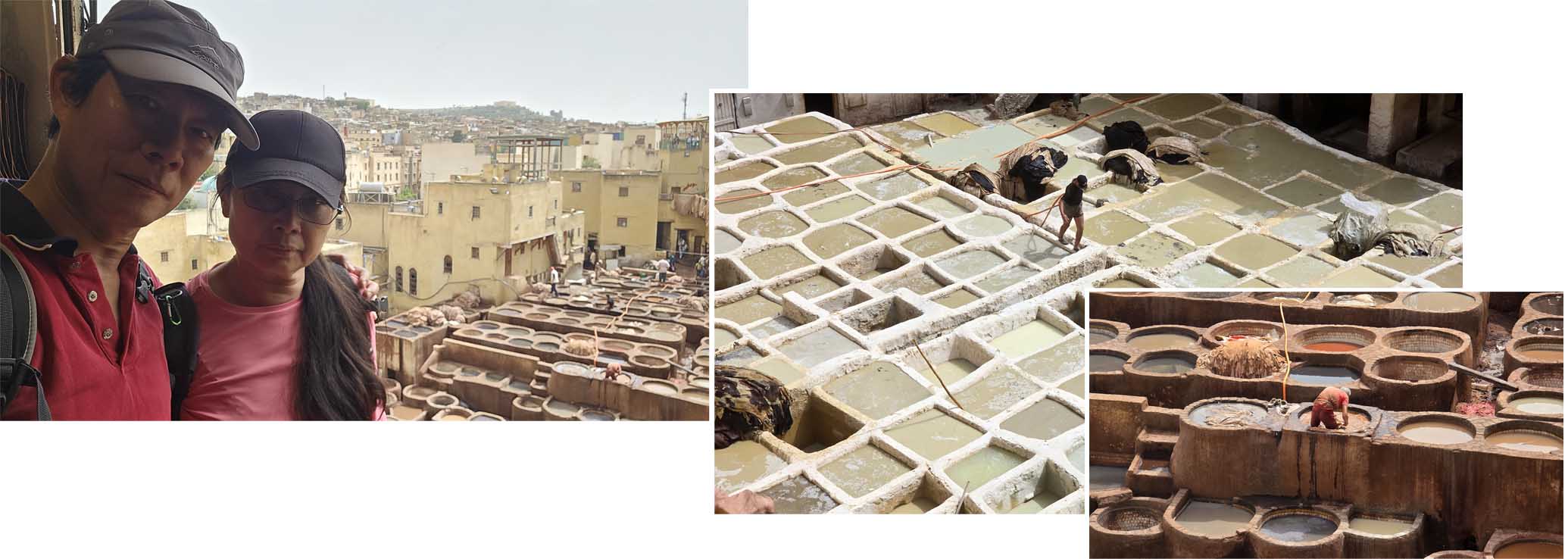
The aroma coming up from the tannery was very overpowering. We were given mint leaves to chew to mask the smell. The view of the tannery was very amazing. There were hundreds of round and rectangle stone vessels filled with white and color liquids. The hides were soak in the white liquid to soften them and into the color liquid to dye them.

Since the inception of the old city, the tanning industry had been continually operating in the same fashion till the present day. Today Fez tanning industry was considered one of its main tourist attractions. It was amazing to see this ancient form of tanning in today’s world!
Our Stay in Fez
Our stay was located on the first lane next to Bab (gate) Ziat, one of the many gates of the old medina, Fez el Bali. We had chosen this stay because we saw a Parking Garage (on google map) just near by. To our surprise upon crossing the Bab, there was road side parking. This parking was even nearer to our stay. The parking fee of 55dh for two days.

Our stay had a long name it was “Dar Ben Daoud avec piscine et terrasse privee” which we booked on booking.com. Our host met us on the street and walked us down a lane to the door of our stay. He handed over the house key and introduced the place to us.
Wow the house was amazing. It was a Moroccan house and the interior were covered with zellige tiles. In the house was three huge bedrooms and one was facing a small swimming pool.

The house has two large bathrooms, one attached to a bedroom and another was a gigantic bathroom in a common area. All this space for only just Eur170 for two nights!

About the house were several sitting areas. Some in the bedrooms, some outside the bedrooms, one outside the patio just beside the swimming pool and another on an upper deck. This house was so amazing.


After many days of dining out, we were only too happy to cook our own meals. A simple meals would be very refreshing and more to our taste buds. We took out our can food, pork stew and luncheon meat and with eggs we were able to make mayo eggs!

Other Accommodations