Lhasa to Shigatse
After four days in Lhasa were were so ready to move on. Our final destination for the day was Shigatse city. Lhasa to Shigatse city was about 357km and the driving time was 6 hr 40min. It was a long “driving” day and made even longer by the breakdown of our van midway.
Along the route we stopped at Yamdrok Lake, Karola Glacier and Palcho Monastery. These stops nicely break our 6-7 hours long journey into parts of 1.5 hours ride. After three days of exploring Tibetan temples, palaces and monasteries, it was wonderful to experience Tibetan beautiful natural wonders!

Shigatse was the 2nd largest city of Tibet and the cultural and spirtual center of western Tibet. It was also known as the main gateway to Mount Everest.
YaJiangHe Valley Viewpoint
Our first stop was at a view poin, YaJiangHe 雅江河谷观景台, it was about 30km or 30 minutes before the first view point of Yamdrok Lake. At YaJiangHe Viewpoint, the parking space was very limited and it was already packed with vehicle when we arrived. Our driver let us alighted and had to drove off so as not to block the incoming vehicles.

The view point was 4280m above sea level and there we could see the vast valley and town below. It was close to two hours since we left Lhasa and we needed a “leg break” badly.
At the viewpoint there were several “cute” animals on displayed. Their owners dressed them up to catch the attention of the tourists. The owners charged a small fees to let tourists posed with their animals in a photo. The Tibetan Mastiffs

Yamdrok Lake
Our second stop was at Yamdrok Lake, 羊卓雍错, view point. Yamdrok Lake also known as Yamdrok Yumtso or Yamzho Yumco. It was freshwater lake and was one of the three largest lakes in Tibet. It was over 72 km long. The lake was surrounded by many snow-capped mountains and was fed by numerous small streams.
The Tibetans considered mountains and lakes sacred as they were the dwelling places of protective deities and therefore they were invested with special spiritual powers. Yamdrok Lake was one of the three holiest lakes of Tibet, the the two were Namtso Lake (we would be visit two days later) and Manasarovar Lake.
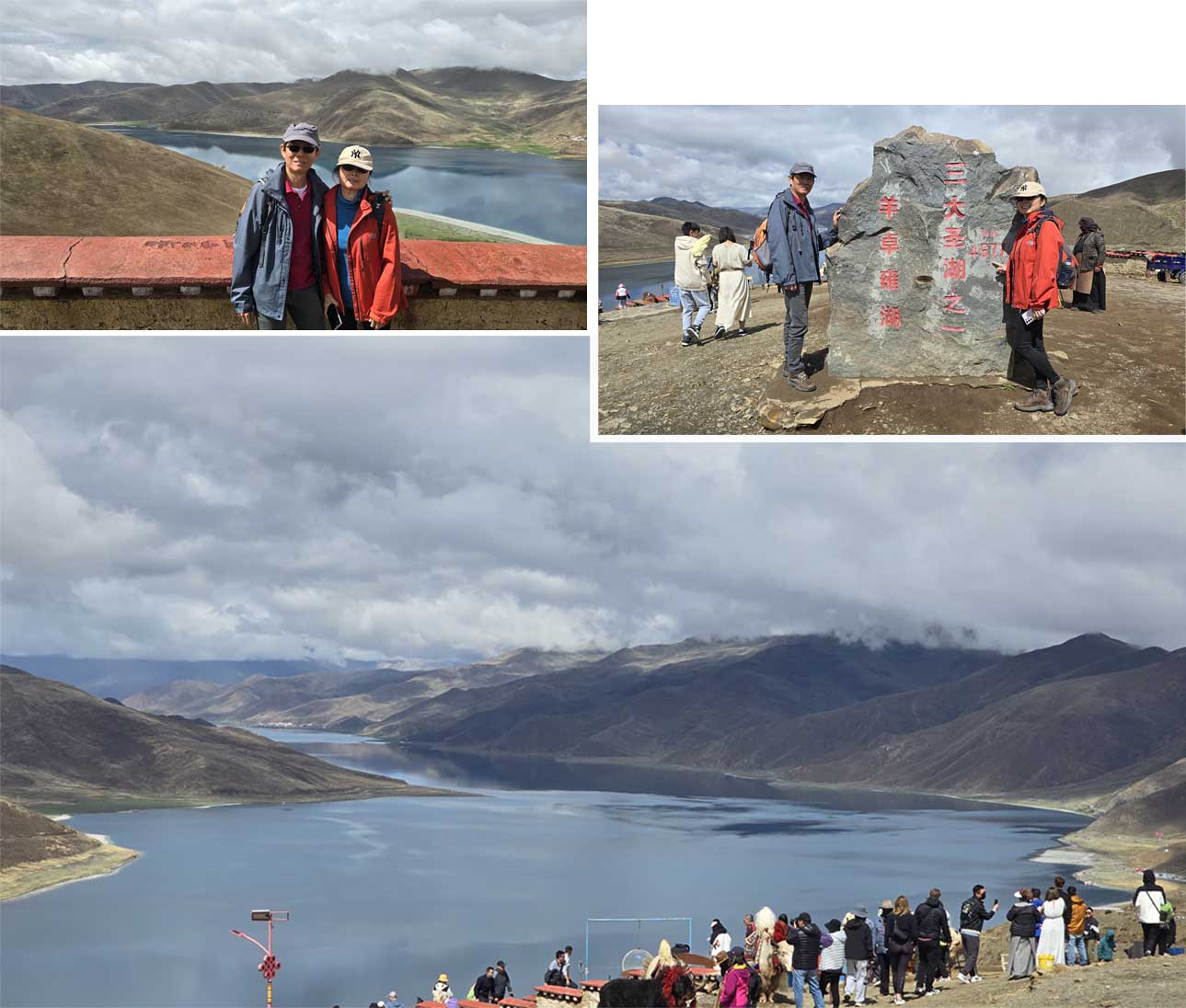
We were a bit disappointed as the lake was not as “turqouise blue” as it was famous for. Neverthless the paranoma view of the lake was beautiful. Looking at lake in the map we thought it took the shape of a scorpio.
We were on our way to the another viewpoint of Yamdrok Lake, this next viewpoint was at the lake level which was about 16km away. Unfortunately before we could reach the viewpoint our van came to a stop by the side.
Our driver said the van had a problem (we did not know what was the problem) and would not be able to carry on. We would have to wait for a replacement van to come from Lhasa. Wow, this was a so unexpected!

We started waiting for our replacement van at the side of the road, eating chips and biscuit to kill time. Soon we were bored and left our driver and guide by the side of the broken van and walked forward to the 2nd view point. Luckily it was just a km of flat walking.
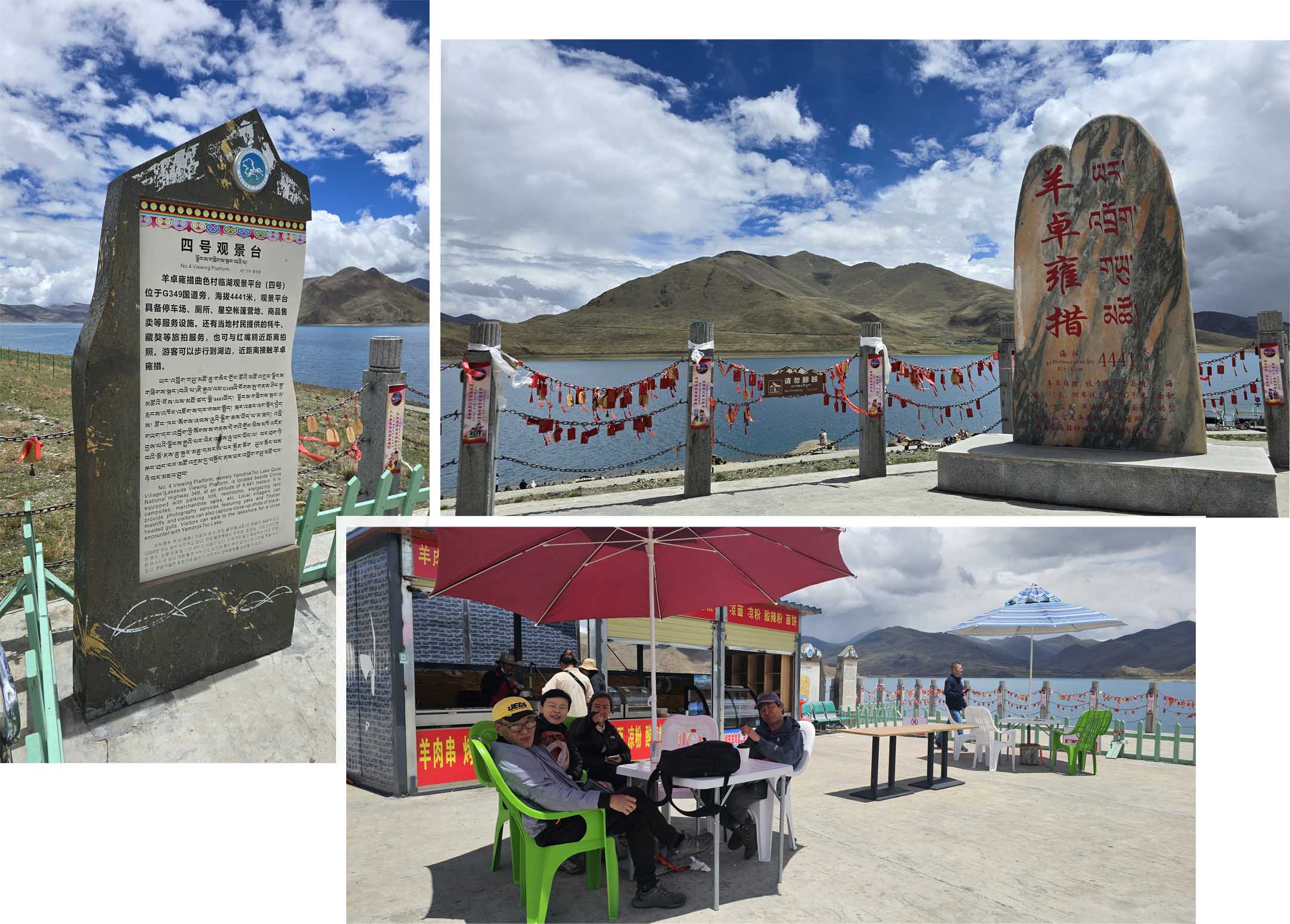
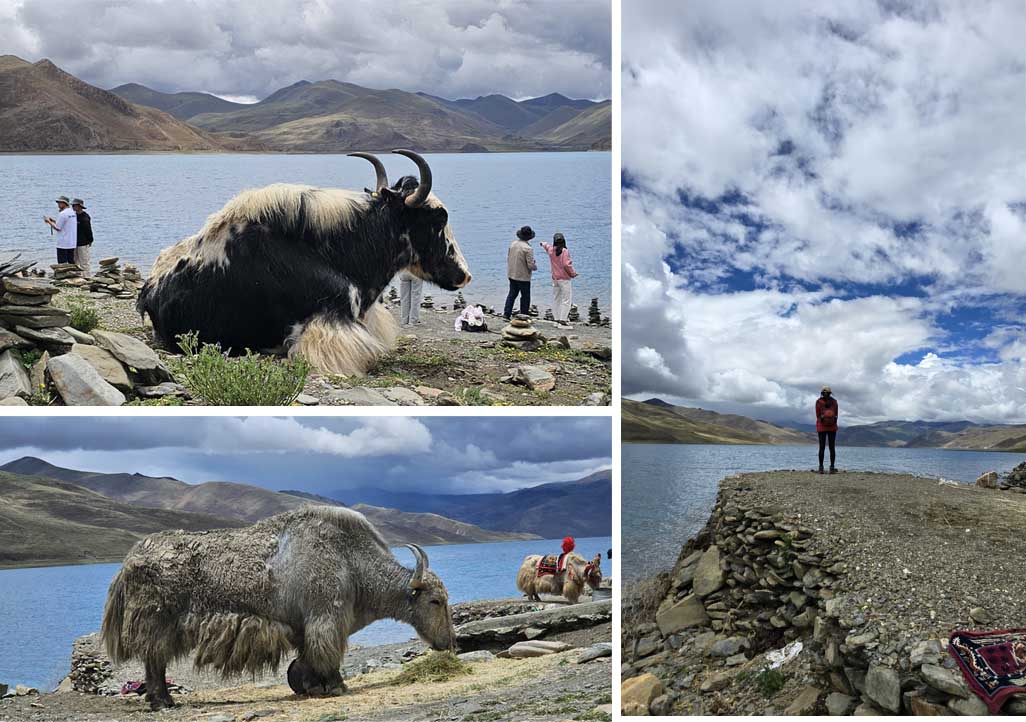
This viewpoint was the 4th Observation deck of Yamdrok Lake. It was at the water level of the lake and there was a cafe/food shop there too. This observation deck was not as crowded as the one before, it seemed like not many tourists came this way. We walked around the vicinity taking more photos of the lake. There was a couple of huge yaks tied to poles near the lake, we supposed these yaks were for tourist-photoshots purposes.
Apparently there were 5 observation decks around Yamdrok Lake. Deck 1 was at the highest level and deck 4 was at lake water level.
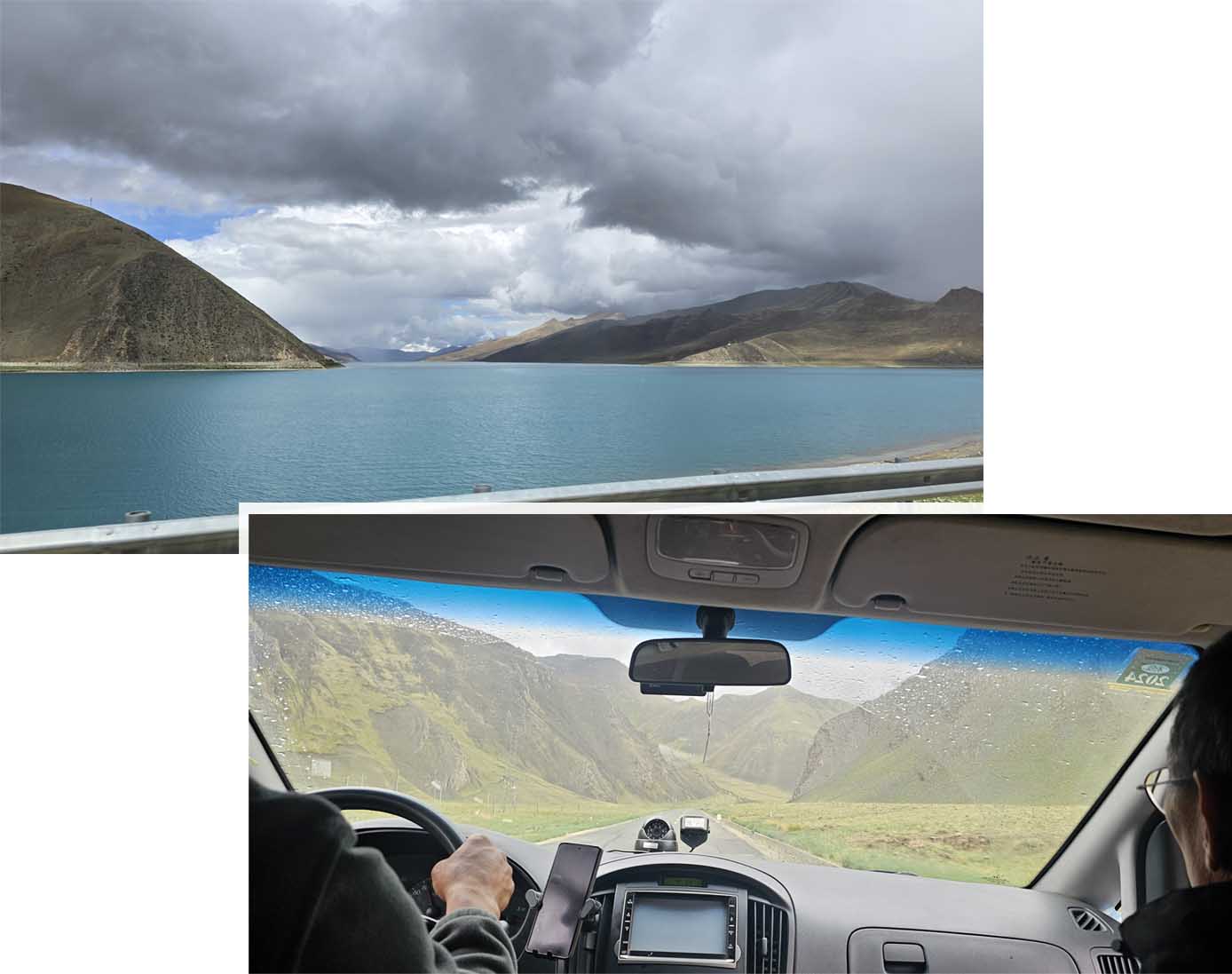
Finally after 3.5 hours later the replacement van arrived! We had lost 3.5 hours and we wondered how it would affect our schedule for the rest of the day.
Karola Glacier
From Yamdrok Lake to Karola Glacier 卡若拉冰川 was about 1 hour 15 min. Along the way we drove passed lovely landscape of mountain ranges ith snow cap tops.
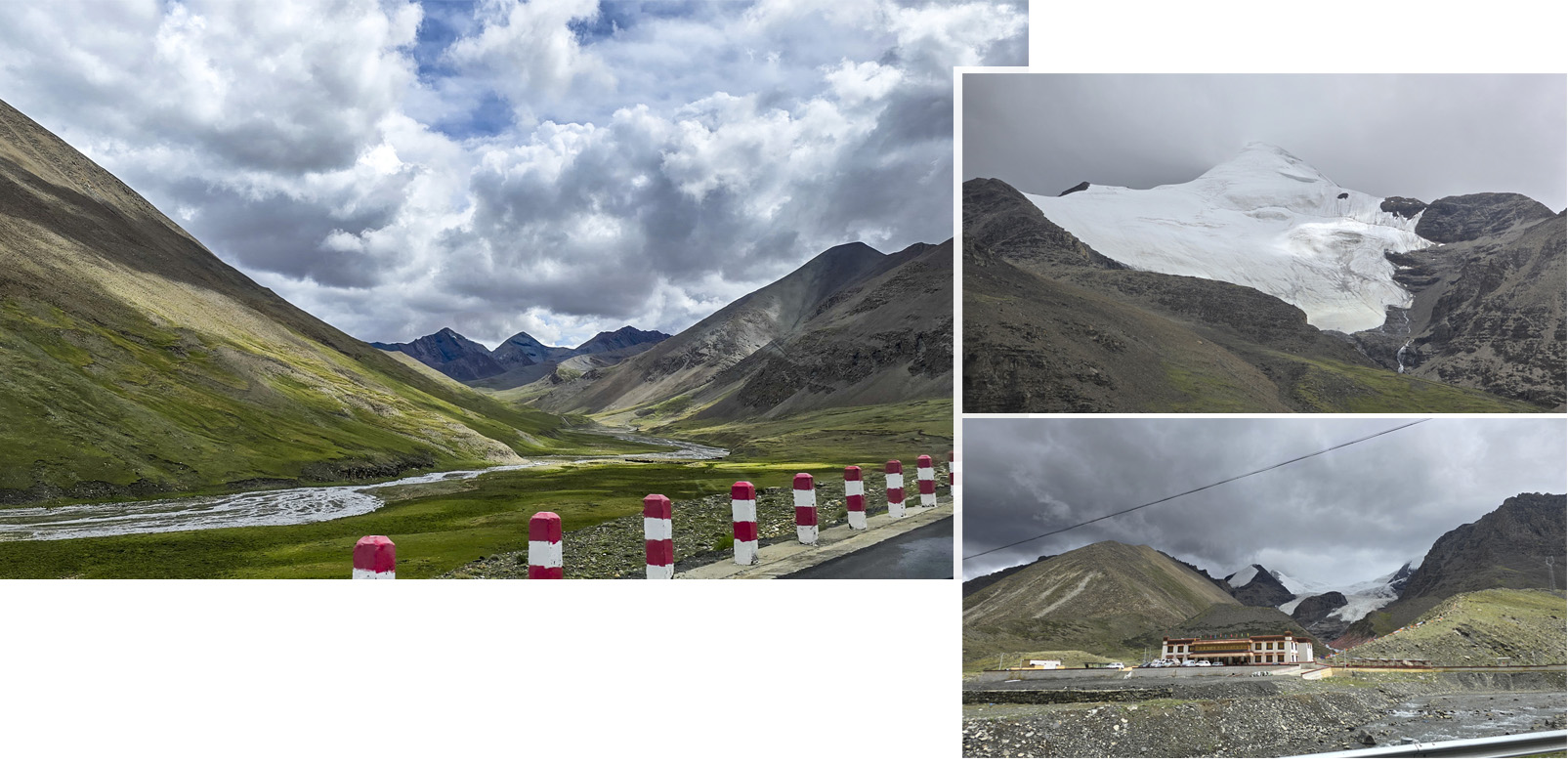
We arrived at the base of Karola Glacier and there were already many visitors at the base site. The base of Karola Glacier was at an elevation of 5020m above sea level. Though it was high we were glad that we suffer no altitude sickness, we had to remind ourselves to go slow as at high altitude sudden action could result in “altitude sickness.
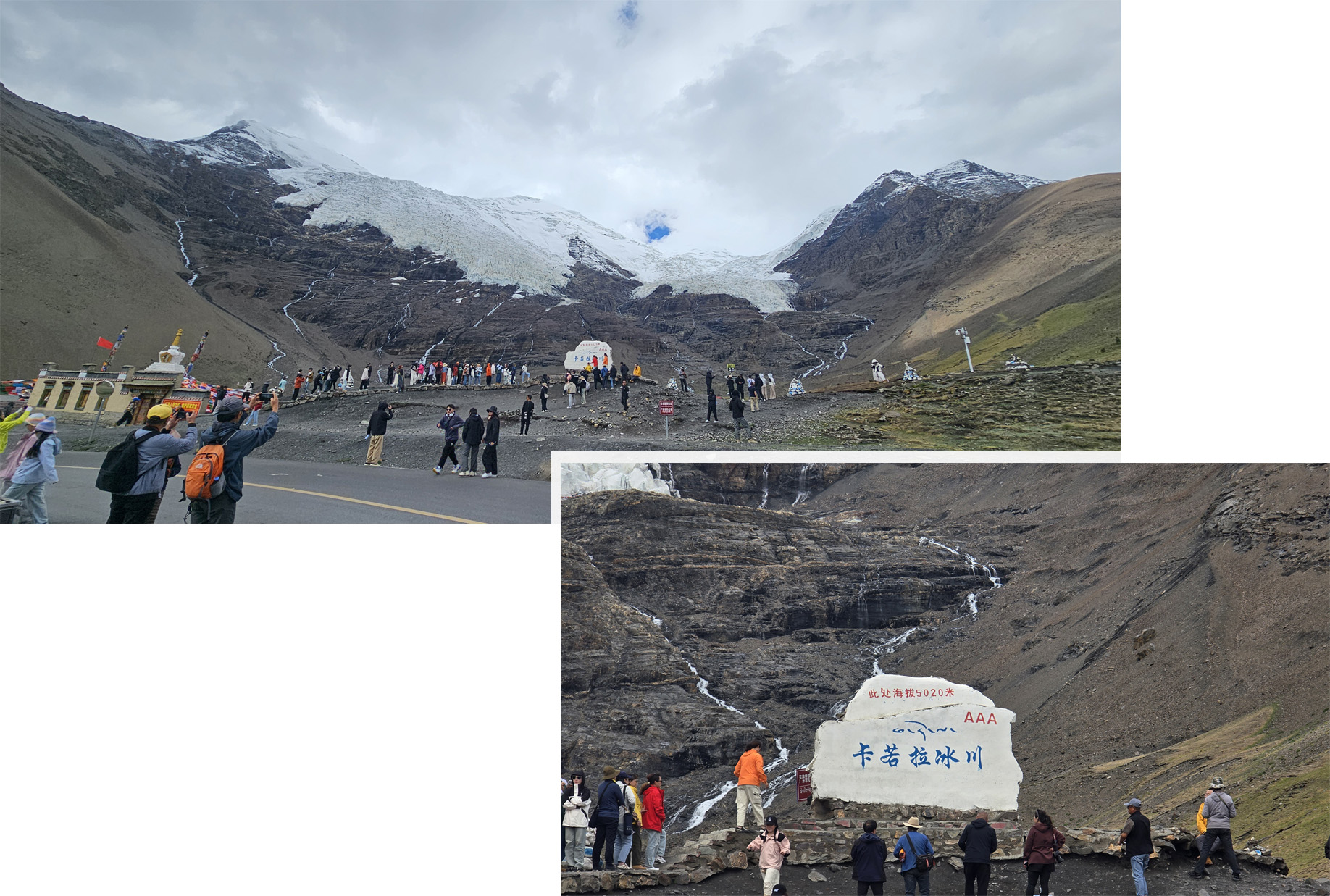
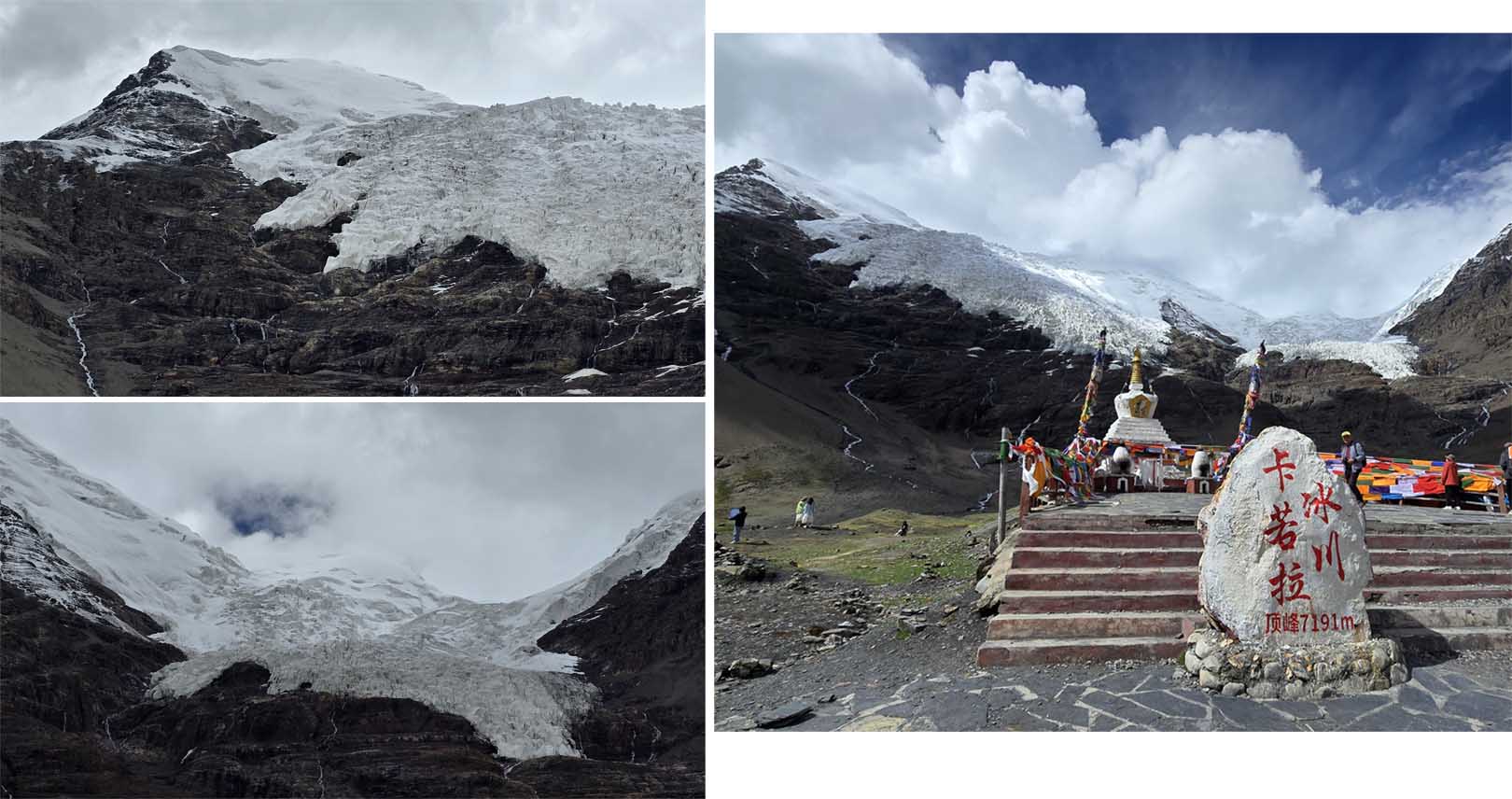
We could see the glacier though the upper part was partially obstructed by cloud/mist. As the cloud/mist spreaded out we could see up the mountain where the glacier began. The glacier descended down the south face of Mount Noijin Kangsang and we could see several tongues. It was amazing that these tongues could be easily seen from the base. In many other countries (like Iceland and New Zealands) we had to trek for hours to see glacier tonques.
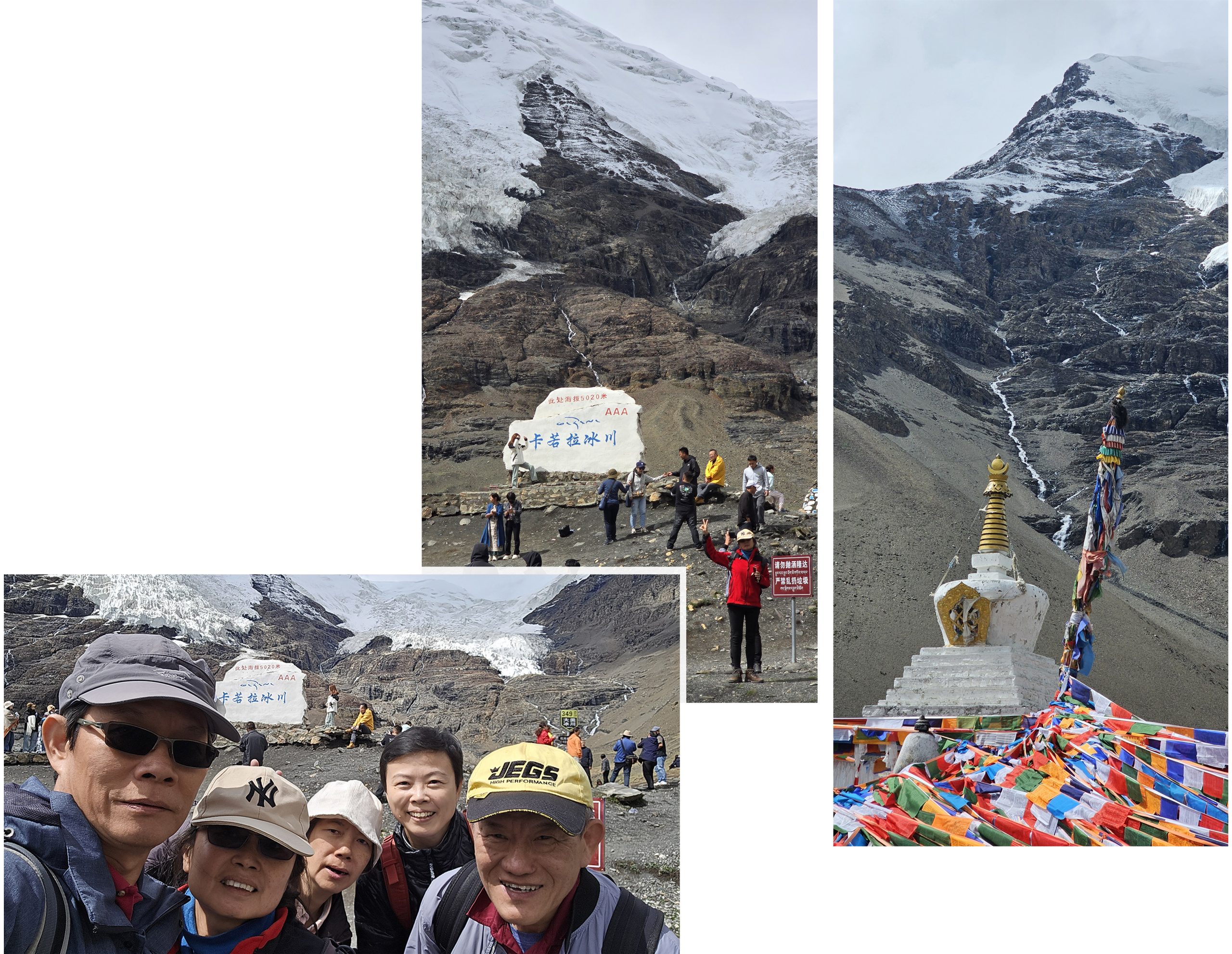
Mount Noijin Kangsang was one of the four greatest snow-capped mountains in Tibet. In its ravines, were over 100 glaciers which cover a total area of 118.82 square kilometers. Among these glaciers, Karola Glacier was the biggest one occupying 9.4 square kilometers. At the base we saw a stone sign indicating that the altitude of Karola Glacier was 7191m. We supposed that would be the elevation of the summit of Mount Noijin Kangsang.
Manla Reservior
From Karola Glacier was a 45-minute drive to Manla Reservoir Scenic Area, 满拉水库观景区. Our van stopped at a Simila Pass Viewing Platform and we came down for a short exploration.
From the platform we saw a beautiful “green pastel color lake”. The lake was actually a reservoir. Though the reservoir was manmade, it blended so well with the natural surrounding canyons and mountains that one would not know that it was artificial.
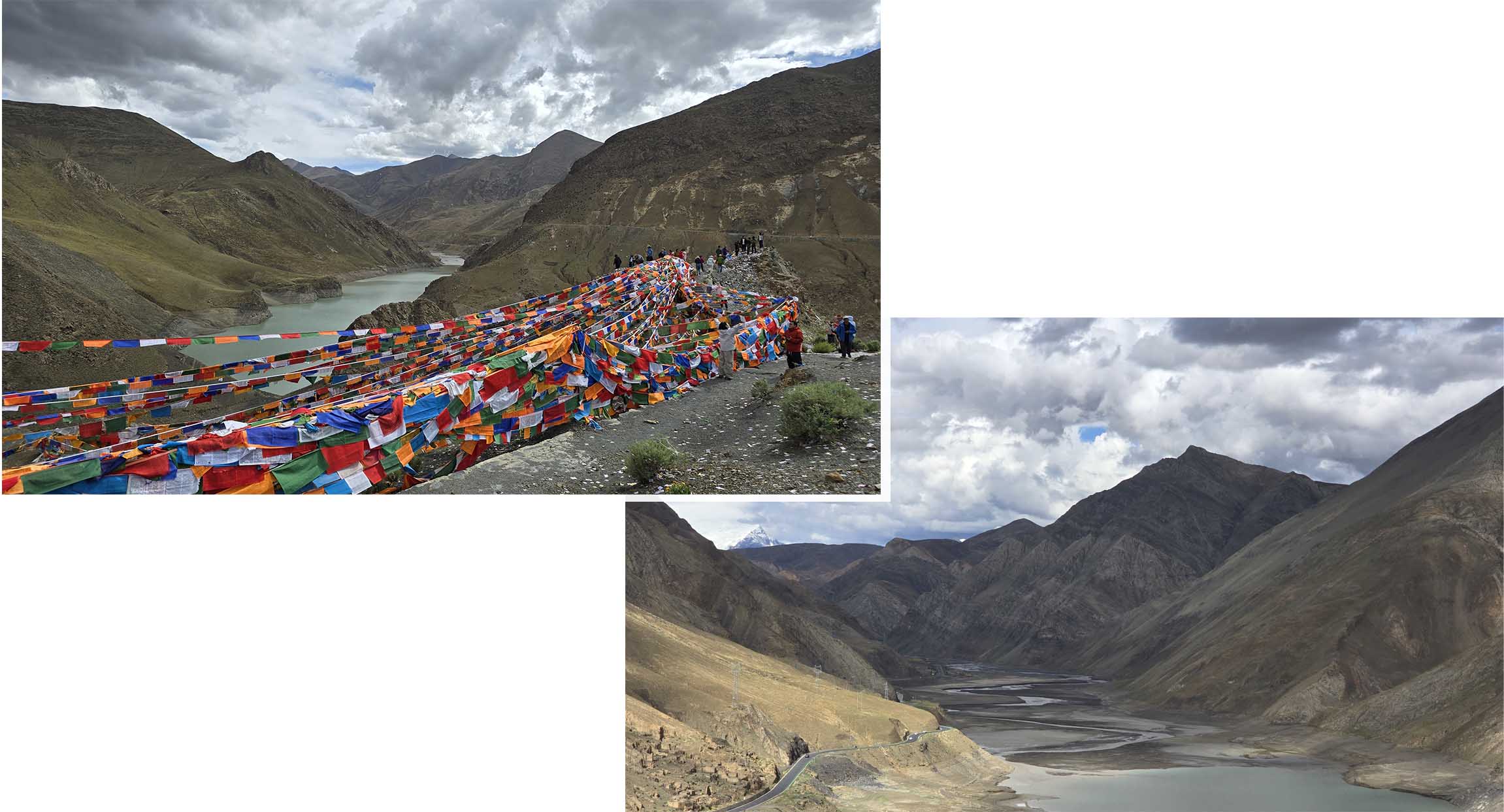
Manla Reservoir was a large-scale water control project completed around the year 2000. The construction of the dam stood over 150m high across the river (Nyang Chu River) created a magnificent artificial lake.
Before its construction the Nyang Chu River was very unpredictable. It often ran dry and yet at times it overflowed causing floods and threatening the agricultural heartlands of Gyantse, Bainang and Shigatse.
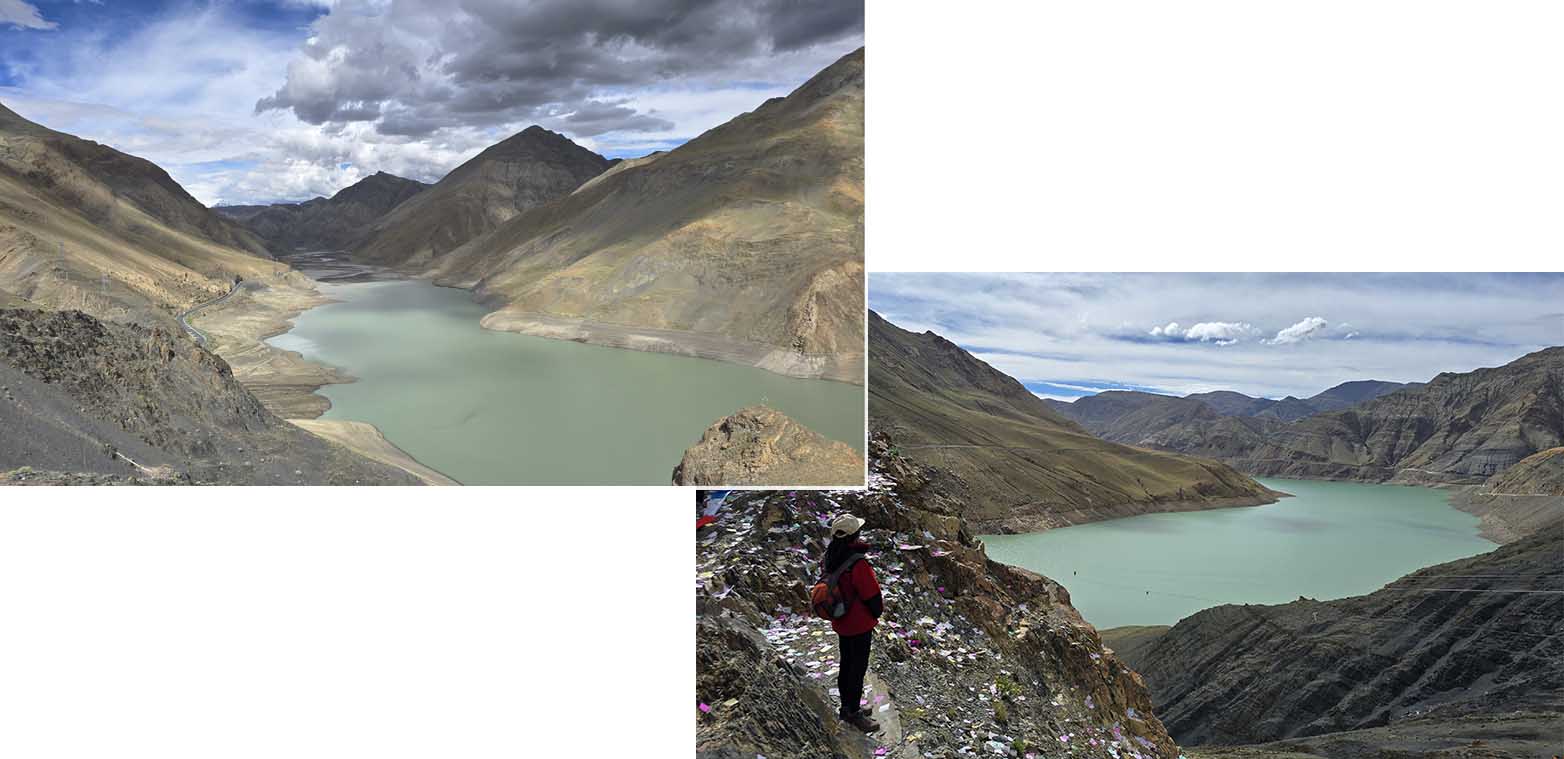
At the viewing deck we saw strings of countless Tibetan colorful prayer flags fluttering in the winds. There were also many small prayer papers scattered about. Prayer flags and papers were Tibetan ways of blessing the surrounding countryside, promoting peace and compassion and wisdom.
Palcho Monastery
From Simila Pass to Palcho Monastery(白居寺) was another 45 minutes drive. We were getting tired of visiting monastery but this was a special monastery so we had to “visit” it. It hosted the largest stupa in the Tibet!
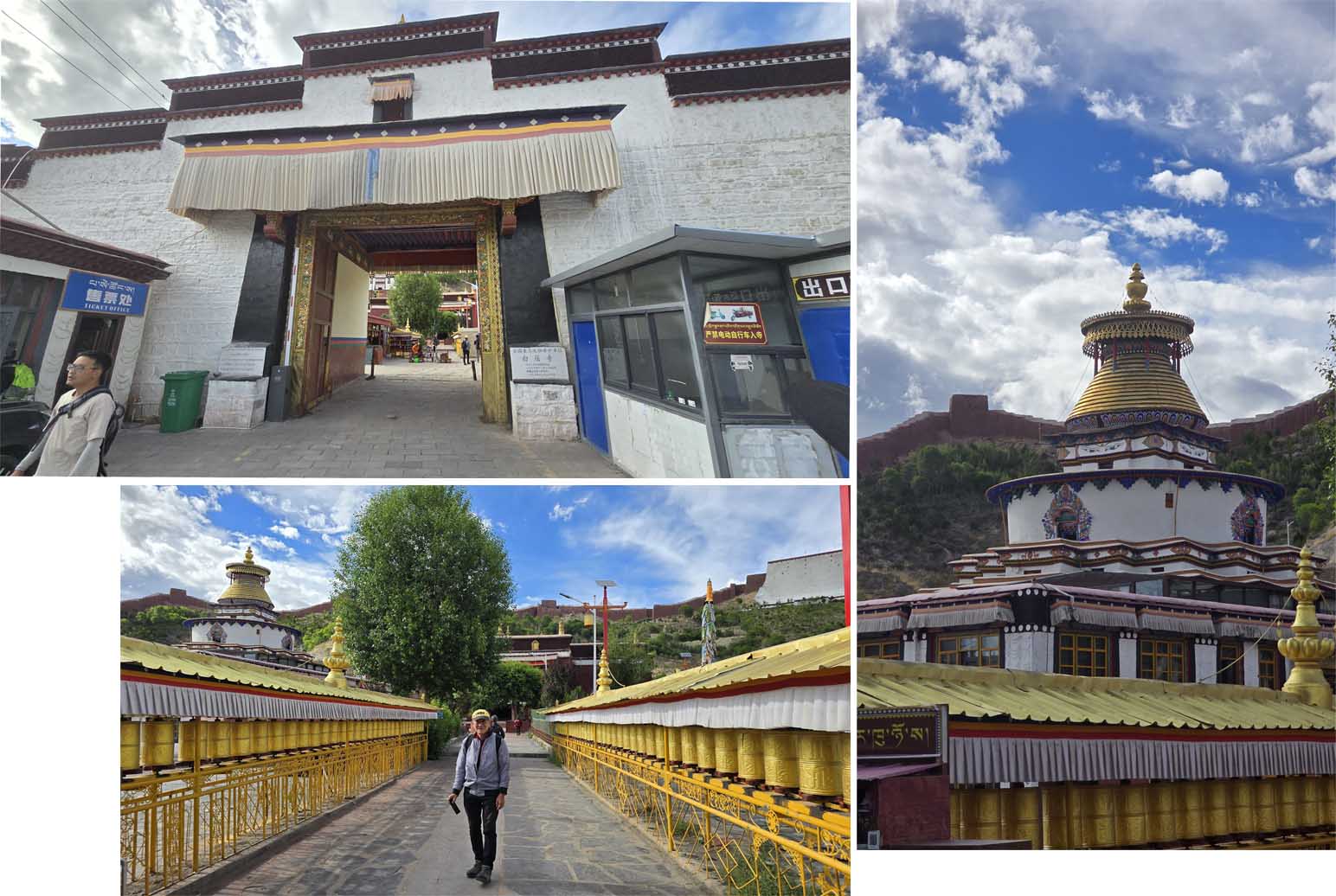
Before “exploring” the Kumbum Stupa we were “hurried” into the main temple, as our guide told us the place was closing soon. The main temple had three floors and many distinctive murals , sculptures dating back to 15th century.
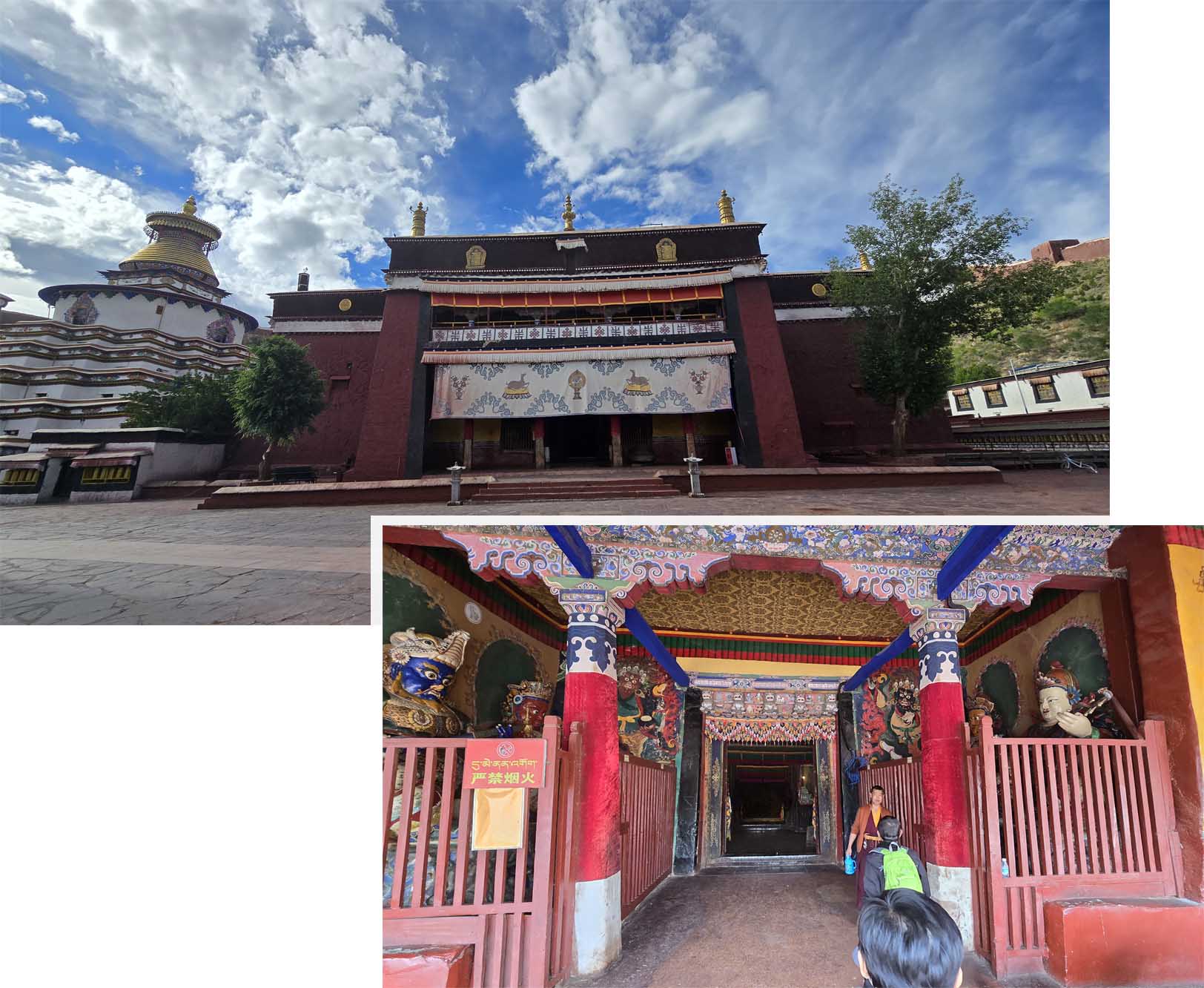
The Palcho Monastery was also called Pelkhor Chode. It was a significant culural and religious site in Tibet. It was a blend of Han, Tibetan and Nepali architecture. The monastery was first built in early 15th century and took 10 years to complete.
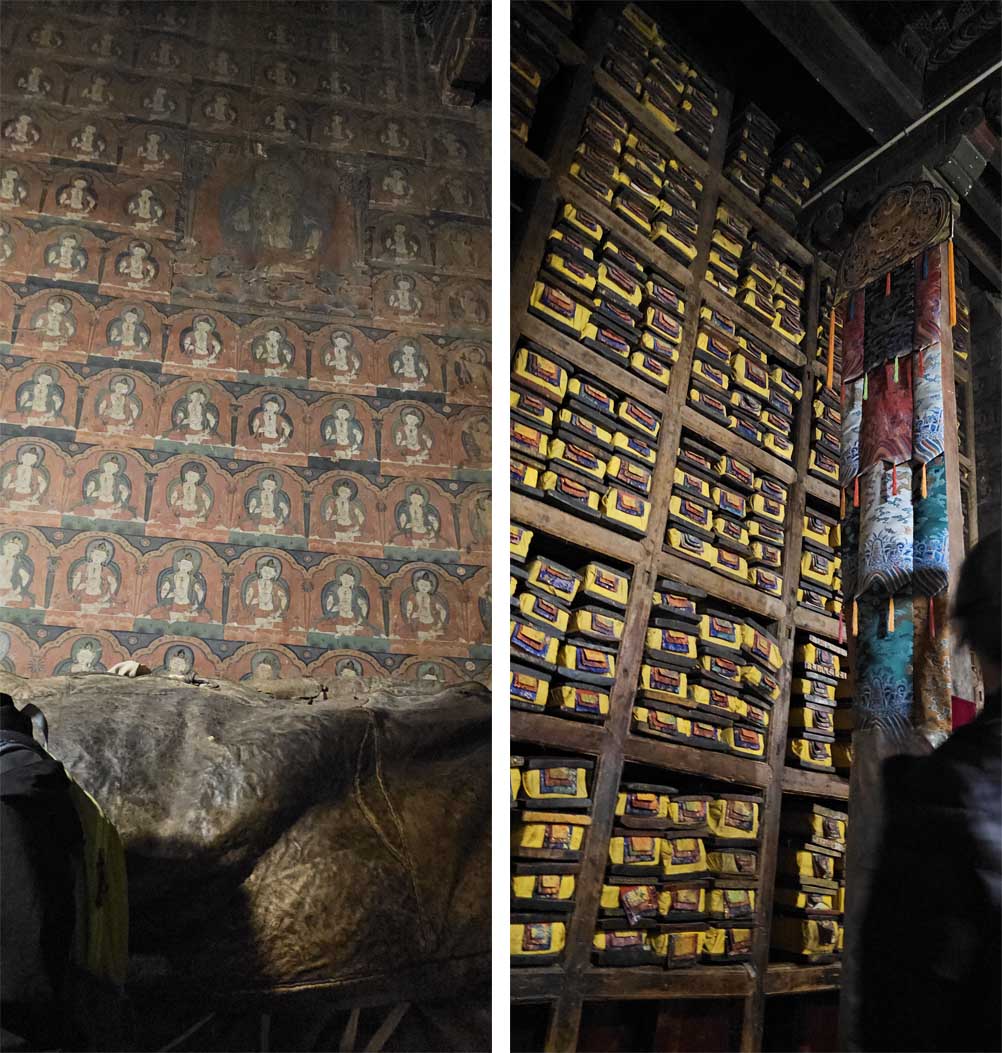
We walked from one hall/room to another. We saw many images/sculptures of Buddha, murals etc etc. At each place our guide would explain about Buddha etc etc. Instead of understanding a bit more we were thoroughly confuse. There were so many versions of Buddhas and how one could tell the images apart. We were not Buddhists so our only idea of Buddha was a Indian Prince long time ago abandoning his wealth to sit and mediate under a tree and eventually ascending to Nirvana. So who were these – Buddha (past life), Buddha (present) and Buddha (future) that our guide were explaining? How we wish that there was a “Dummy Guide on Buddha” so that we could understand our guide explanation.
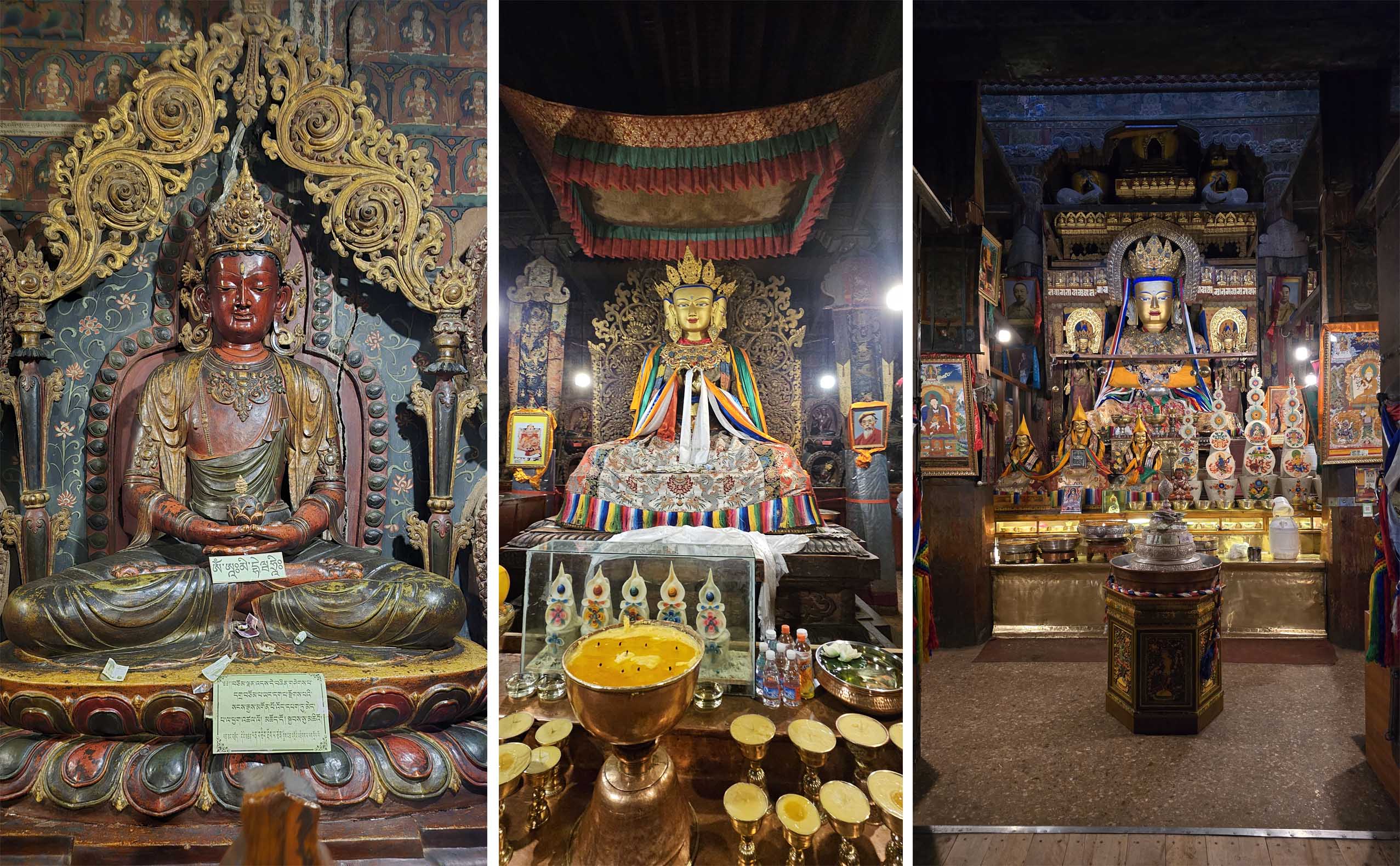
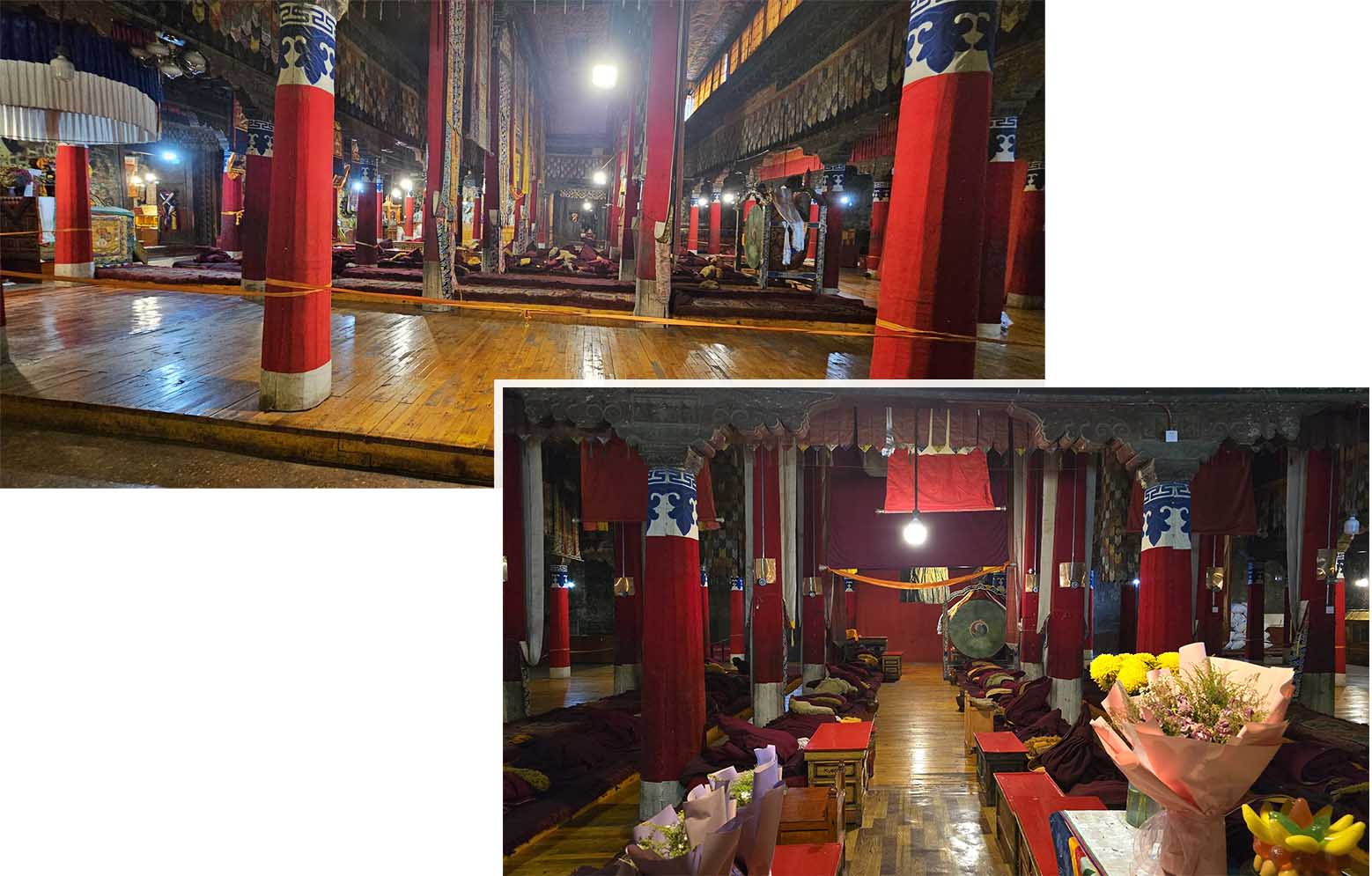
This was the first monastery that the monks allowed us to take photos. So we took some here and there. Apparently the entrance fee to Palcho Monastery was ¥60 per person and for photography another ¥10 per person. As usual the interior of the monastery like all others that we had visited were dim and gloomy.
After the main hall we went to explore Kumbum, a 32 m (105 ft) high, nine-floor stupa with 108 gates and 76 chapels. We climbed up a level at a time and went round it before going up to the next. Thus stupa was more complex than those smaller ones that we had seen. It was “angular” at the base and round near the top.
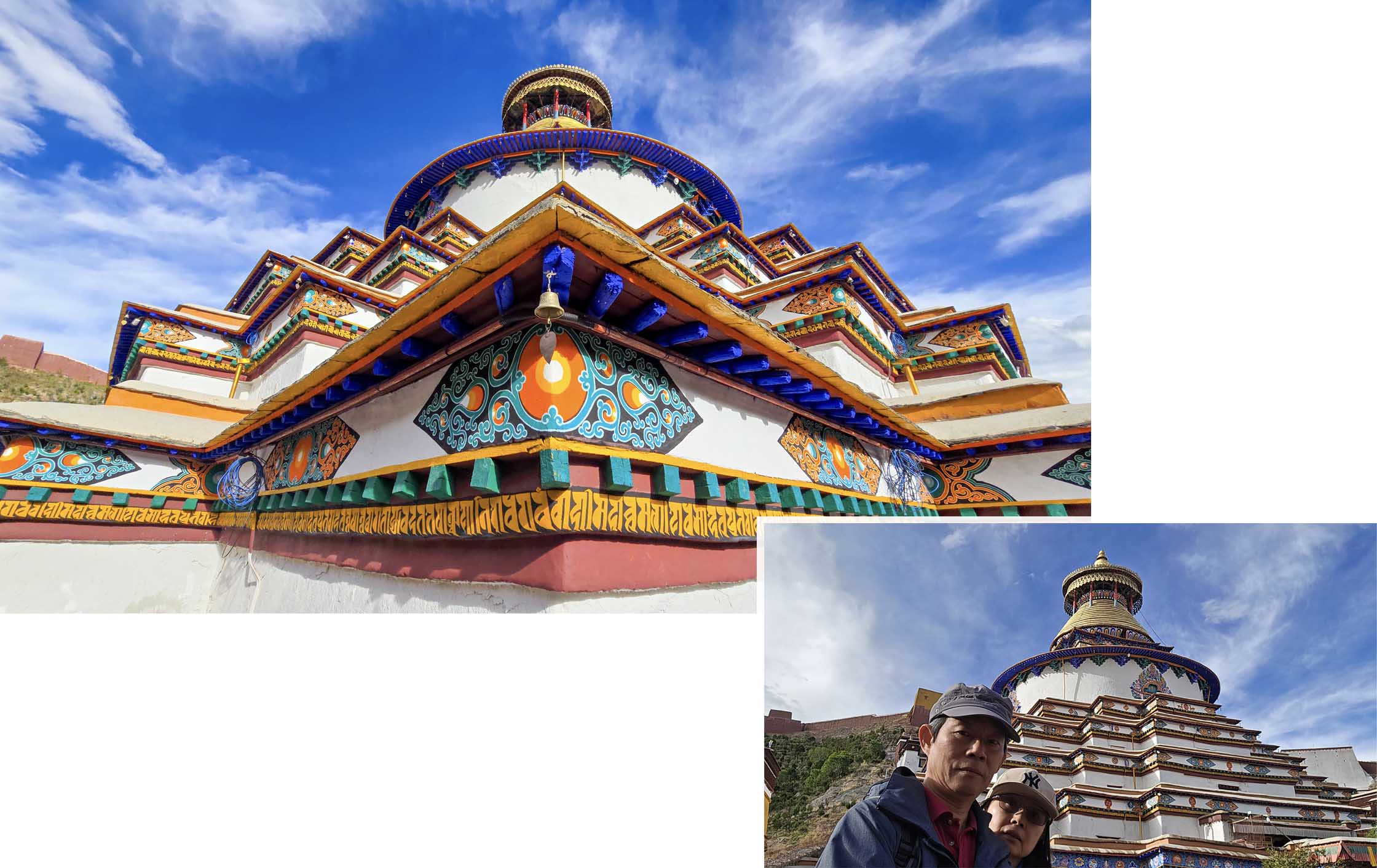
We were not able to get into the higher level of the Kumbum Stupa as some stairs were barricaded. There were supposed to be 10,000 Buddha statues spreaded out in the halls, niches of the stupa but we did not see so many of them as some halls were opened some were closed.
There was a brown brick wall surrounding the Palcho Monastery (Pelkhor Choede). It was a massive, historic fortification built around 1425 to enclose the monastic compound. This wall was central to the monastery’s identity, functioning as a defensive barrier, a container for the temple’s treasures, and a backdrop for major religious festivals.
Gyantse Dzong
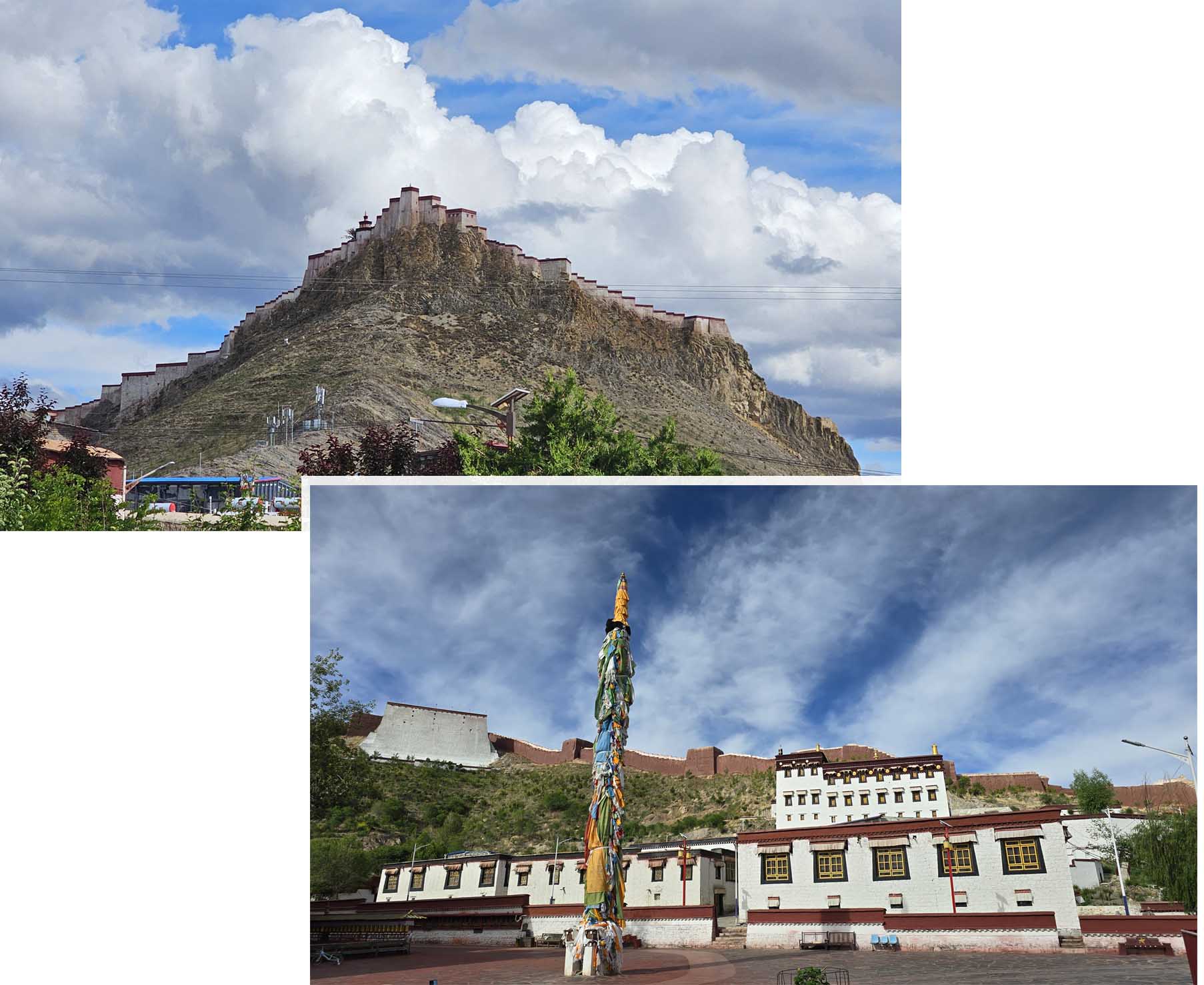
In the same town, Gyantse, as Palcho Monastery we saw a line of white wall on a hill facing the monastery. This was Gyantse Dzong (宗山遗址) also called Gyantse Fortress, built on the rugged hills. This forts were constructed to resist the violation of Britain in 1904.
In our itinerary there was no visit to Gysantse Fortress, but it looked so interesting that we requested our guide to take us there. Unfortunately our request was turned down as it was late and the entry to the fortress closed more than an hour ago.
We supposed if we had not wasted 3.5 hours waiting for our replacement van in the earlier part of the day we would have the time to visit this magnificient fortress.
Shigatse hilton – accommodation for the night
Another 1.5 hour drive took us to Shigatse city where our hotel Shigatse Hilton, 日喀则希尔顿酒店 was sited.
It was a very long day, we started our journey from Lhasa at 8.30 am in the morning and by the time we reached our Shigatse Hilton it was already 9pm. It was so delayed because our van broke down midway and the replacement van took 3.5 hours to arrive.
Shigatse Hilton was lovely. The reception desk was on the 7th floor. We quickly processed our check in, did our “freshen up” and was down to the 1st floor where several restaurants were located for dinner. It was definitely too late to go into town and our guide was of no help when it come to “where to eat”.

Dinner
The only restaurant in Shigatse Hilton that was still open at 9.30pm was a Chinese restaurant. We were too tired to select our “dishes” so we ordered the set dinner for 5 persons. Wow… the meal was a banquet! Too bad we were tired and our appetite had disminished. Dinner was usually at 7.30pm, and eating the meal two hours late was a chore. The cost of this sumptuous dinner worked out to ¥188 per person.

Othe Accommodation in Shigatse
When travelling in China, we liked to book hotels on Trip.com as it show more listings. Though for this trip all our hotels were prebooked by our travel agent.
